
Why Modern Businesses Are Moving Beyond Traditional Phone Lines
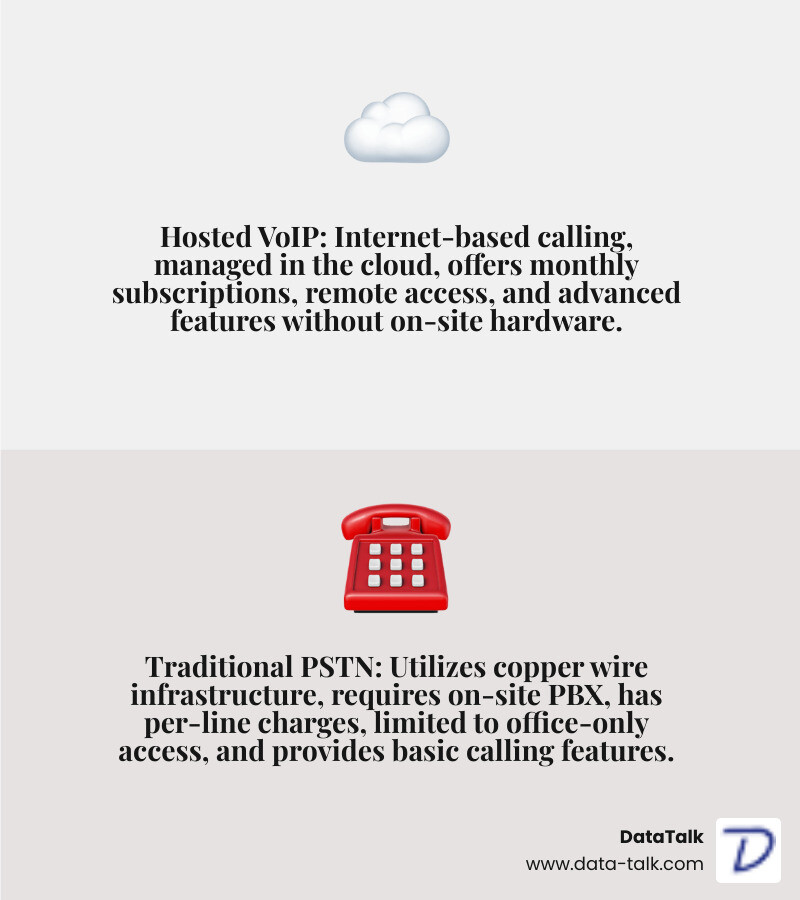
Hosted VoIP solutions are cloud-based phone systems where a service provider manages all servers and infrastructure offsite. Instead of maintaining expensive on-premises equipment, businesses make calls over the internet and access features through apps or desk phones.
Quick Answer: What You Need to Know
- What it is: Internet-based calling managed by a third-party provider
- Key difference: No physical phone system hardware in your office
- Cost: Typically $15-40 per user per month vs. traditional lines
- Requirements: Stable internet connection and compatible devices
- Best for: Businesses wanting flexibility, remote work support, and lower costs
If your Ohio business still uses traditional landlines or an aging on-site PBX system, you’re likely facing high monthly bills, limited features, and constant maintenance. Traditional systems rely on the Public Switched Telephone Network (PSTN), requiring expensive hardware and technician visits for simple changes or repairs.
Hosted VoIP eliminates these problems. Your provider handles everything from secure data centers, giving you enterprise-level features like auto-attendants and call routing that would cost thousands with traditional systems. Your team can work from anywhere with an internet connection, using desk phones, computers, or mobile devices.
However, a stable network is crucial. Not all internet connections are ready for VoIP, and poor quality can lead to dropped calls and choppy audio. Network readiness isn’t optional—it’s essential for a successful switch.
This guide covers how hosted VoIP works, what it costs, key features, and how to avoid common pitfalls, so you can understand what it can do for your business.
What is Hosted VoIP and How Does It Work?
Hosted VoIP solutions work by converting your voice into digital data and sending it over the internet. Here’s a simple breakdown of the process:
- Analog to Digital: When you speak into a VoIP-enabled device (like a desk phone, computer, or smartphone), your analog voice is converted into digital data.
- Compression and Packets: This digital data is compressed using voice codecs to ensure quality without using too much bandwidth. It’s then broken into small data packets for transmission.
- Internet Transmission: These packets travel over your internet connection to your provider’s secure data centers. This eliminates the need for expensive phone equipment in your office, as the provider manages all the hardware and infrastructure.
- Call Management: A technology called SIP (Session Initiation Protocol) acts as the traffic controller, setting up, managing, and ending your calls reliably. You can learn more about the technical details in our guide on What’s the Difference Between VoIP Technology & SIP Trunking?
- Reassembly: At the destination, the packets are reassembled, decompressed, and converted back to an analog signal, resulting in a clear conversation.
One of the biggest advantages of Hosted VoIP solutions is device flexibility. Your team isn’t tied to a single desk phone. They can use:
- IP Phones: These look like traditional desk phones but connect to your internet network instead of a phone jack.
- Softphones: These are apps that turn your computer or mobile device into a full-featured business phone.
- Browser-Based Calling: Make and receive calls directly from a web browser like Chrome, Safari, Firefox, or Edge with no installation required.
This flexibility ensures your team in Dublin, Westerville, or anywhere in Central Ohio can stay connected, whether they’re in the office, at home, or on the road.
The Core Business Benefits of Switching to Hosted VoIP
For businesses in Ohio, from Dublin to downtown Columbus, a modern phone system is a competitive necessity. Hosted VoIP solutions deliver measurable benefits that improve both your bottom line and daily operations.
Significant Cost Reduction
Traditional phone systems come with complex bills for line rentals, maintenance contracts, and per-minute charges. Hosted VoIP replaces these with a simple, predictable model.
- No Expensive Hardware: You eliminate the large capital expense of an on-site PBX system. The provider manages all hardware in their data centers.
- Predictable Monthly Billing: Most providers offer a flat per-user-per-month rate (typically $15-$40), making budgeting easy. Many businesses save over 50% on their phone bills. See how the numbers add up in our guide, Is VoIP Worth It for a Small Business Phone System?
- Lower Calling Costs: Many plans include unlimited domestic calling, and international rates are significantly cheaper than traditional carriers.
Best Scalability
With traditional phones, adding or removing lines requires a technician and can take days. Hosted VoIP solutions let you scale on demand. Adding or removing users takes minutes through a simple online portal, whether you’re hiring new staff, opening a new office in Cincinnati, or adjusting for seasonal demand. Your communication system can grow with your business, a key strategy we explore in Five Strategies to Make Your Business More Scalable in 2024.
Improved Mobility for Modern Work
Today’s workforce is mobile. Hosted VoIP solutions are built for this reality, allowing your business number to follow employees anywhere. They can take calls on a laptop, smartphone, or tablet, ensuring they never miss an important call whether they’re in Clintonville or working from home. This ability to work from anywhere keeps your team productive and your customers happy. Learn more about the benefits for remote teams in our article on Common Benefits of VoIP Business Phone Systems for Remote Working.
Access to Advanced Features
Enterprise-level features like auto-attendants, call recording, and voicemail-to-email are now standard with Hosted VoIP solutions. These tools provide professional call handling that makes any size business sound established. This levels the playing field, giving small businesses the same powerful communication tools as large corporations. Find more in Why Small Businesses Need VoIP Phone Systems.
Improved Business Continuity
If a power outage hits your office, a traditional phone system goes down. With hosted VoIP, the system lives in the cloud. Calls can be automatically rerouted to mobile devices or other locations, ensuring your business stays online. This “always on” reliability prevents lost sales and frustrated customers, keeping you reachable even when your physical office is not.
Navigating the VoIP Landscape: Key Comparisons and Costs
Choosing the right communication system for your Ohio business involves understanding the key differences in technology, responsibility, and cost.
Hosted VoIP vs. On-Premises VoIP: Which is Right for You?
The main difference is where the phone system hardware (the PBX) lives and who manages it. With Hosted VoIP solutions, the provider manages everything in their data centers. This is an operational expense (OpEx) model with a predictable monthly fee. With on-premises VoIP, you buy and maintain the hardware in your office, which requires a large capital expense (CapEx) and dedicated IT resources.
| Feature | Hosted VoIP Solutions | On-Premises VoIP Solutions |
|---|---|---|
| Infrastructure | Managed by provider offsite in data centers | Physical PBX hardware located in your office |
| Upfront Investment | Low (OpEx – operational expense) | High (CapEx – capital expense for hardware, installation) |
| Maintenance | Handled entirely by the provider | Requires internal IT staff or dedicated vendor contracts |
| Scalability | Highly flexible; easily add/remove users/features | Can be complex and costly to expand or reduce capacity |
| Control | Less direct control, relies on provider’s offerings | Full control over customization and system configuration |
| IT Requirements | Minimal; just good internet access | Significant; requires skilled IT staff for management |
For most small to medium-sized businesses in Columbus or Grove City, Hosted VoIP solutions are the clear choice due to lower upfront costs, reduced maintenance, and superior scalability.
Hosted VoIP, Cloud VoIP, and Hosted PBX: Understanding the Terms
While often used interchangeably, these terms have specific meanings:
- VoIP (Voice over Internet Protocol): The core technology that sends voice calls over the internet.
- PBX (Private Branch Exchange): A private phone network within a company.
- Hosted PBX: Moves the PBX hardware to the provider’s cloud data center.
- Hosted VoIP / Cloud VoIP: Broader terms for a fully managed phone service where the provider handles all technology and infrastructure.
Essentially, your provider manages the technology in the cloud so you can focus on your business. This technology is constantly evolving, as detailed in our article on Latest Tech Advancements That Are Reshaping Hosted PBX & Cloud Telephony.
Comparing Costs: Hosted VoIP vs. Traditional Phone Bills
Traditional phone bills are complex and unpredictable. Hosted VoIP solutions offer simple, predictable pricing, typically a per-user-per-month fee. For businesses in the Columbus area, this usually ranges from $15 to $40 per user, including a full suite of features.
Key financial benefits include:
- Elimination of Line Rental Fees: You no longer pay for physical copper lines.
- Reduced Calling Charges: Most plans include unlimited domestic calling and much lower international rates.
- Lower Total Cost of Ownership (TCO): With no hardware to buy, maintain, or upgrade, the TCO for hosted VoIP is often over 50% lower than for traditional systems. The provider handles all maintenance and updates automatically.
This modern approach makes your phone system a tool for growth, not just a cost center. We explore this further in Why Small Businesses Need VoIP Phone Systems.
Essential Features to Look for in Hosted VoIP Solutions
Modern Hosted VoIP solutions come with powerful features that were once reserved for large enterprises. These tools are typically included in standard plans, giving small businesses in Columbus a competitive edge. Here are the essential features to look for:
Auto-Attendant (IVR): A virtual receptionist that greets callers with a professional menu (“Press 1 for Sales, 2 for Support”) and directs them to the right department. Learn more in our guide to 8 Things That Business Owners Should Know About IVR Systems.
Advanced Call Routing: Ensure calls always reach the right person. Features like Ring Groups (ringing multiple phones at once) and Find Me/Follow Me (sequentially calling your desk phone, then mobile) prevent missed opportunities. We cover these in Everything Business Leaders Need to Know About Call Routing.
Voicemail-to-Email & Transcription: Receive voicemails as audio files in your email inbox, often with a text transcription, allowing you to quickly scan messages and prioritize callbacks.
Call Recording: An invaluable tool for training, quality assurance, and dispute resolution. Recordings are stored securely in the cloud for easy access. Find the benefits in Valuable Ways Call Recording Can Benefit Your Business.
CRM and App Integrations: Connect your phone system to tools like Salesforce or HubSpot. This enables features like screen pops (displaying caller info) and automatic call logging, saving time and improving customer service. See how to set this up in our Comprehensive Guide to Integrate VoIP CRM Technology at Your Business.
Number Portability: Keep your existing business phone numbers when you switch. Your customers in Worthington and Grove City will experience a seamless transition.
Security and Encryption: Essential for protecting your communications. Look for providers that offer end-to-end encryption, multi-factor authentication, and compliance with standards like HIPAA or PCI DSS.
Potential Challenges and the Evolution to UCaaS
While Hosted VoIP solutions are powerful, they rely on a stable internet connection. Understanding and preparing for potential challenges is key to a successful implementation.
Mitigating Potential Hosted VoIP Challenges
Internet Quality: Your internet connection is the foundation of VoIP. Insufficient bandwidth or issues like jitter (inconsistent data delivery) and latency (delays) can cause choppy audio and dropped calls. This is why we perform a VOIP Scout Test before any deployment to assess your network’s readiness and ensure crystal-clear call quality from day one.
Security: Any internet-connected system requires strong security. Choose a provider that offers call encryption, multi-factor authentication, and secure data centers. Your business should also follow best practices like using strong passwords and firewalls. Learn more in our guide on How Your Business Can Protect Your VoIP Phone System.
Power Outages: VoIP phones and routers need power. A battery backup (UPS) for your network equipment is a wise investment. Additionally, hosted systems offer failover routing, which automatically redirects calls to mobile phones or other locations during an outage, ensuring business continuity.
The Next Step: How UCaaS Builds on Hosted VoIP
Unified Communications as a Service (UCaaS) is the evolution of hosted VoIP. It integrates voice with other communication tools into a single platform.
UCaaS combines Hosted VoIP with video conferencing, instant messaging, file sharing, and presence status (seeing who is available). Instead of juggling multiple applications, your team can seamlessly switch from a phone call to a video meeting or chat with a colleague from one interface.
This single-platform efficiency boosts productivity, especially for remote and hybrid teams. It streamlines collaboration and reduces the time spent switching between apps. We explain how this transforms operations in How Unified Communications Can Make Your Company More Productive. A unified platform is also invaluable for relocating businesses, as all communications tools move with you in the cloud. We cover this in our article on Reasons Why Businesses Should Switch to Our Cloud-Based Unite Platform When Relocating.
Frequently Asked Questions about Hosted VoIP
Here are answers to common questions from Ohio businesses considering Hosted VoIP solutions.
Can I keep my current business phone number?
Yes. Reputable providers offer number portability, allowing you to transfer your existing local, toll-free, or vanity numbers to the new service. This ensures business continuity for your customers and means you won’t have to update marketing materials. Keeping your local Ohio number is a standard and straightforward process.
What internet speed do I need for reliable call quality?
A general rule is that each standard VoIP call requires about 100 kbps of both upload and download bandwidth. For 10 simultaneous calls, you would need at least 1 Mbps of dedicated bandwidth for voice traffic, in addition to bandwidth for your other business activities. A stable, high-speed connection like fiber is ideal. Before any installation, we conduct a thorough “VOIP Scout Test” to assess your network and guarantee it can support high-quality calls.
Is Hosted VoIP secure enough for my business?
Yes, a quality provider ensures robust security. Key features include call encryption, multi-factor authentication (MFA), and infrastructure hosted in secure data centers with firewalls and intrusion detection. Providers should also meet compliance standards like HIPAA or PCI-DSS where required. While the provider secures the service, your business should also use strong passwords and secure your local network to maintain a safe communication environment.
Conclusion: Future-Proof Your Business Communications
Hosted VoIP solutions are a strategic necessity for modern businesses seeking to be agile and competitive. They deliver substantial cost-savings by eliminating expensive hardware and unpredictable fees, provide the flexibility for your team to work from anywhere, and offer advanced functionality that levels the playing field with larger competitors.
However, the success of any VoIP system depends entirely on the quality of the underlying network. Poor internet performance leads to dropped calls and frustrated customers. This is why a network assessment is not just a recommendation—it’s a requirement for a successful deployment.
At DataTalk, we address this head-on with our unique “VOIP Scout Test.” Before installation, we thoroughly assess your network’s health to identify and resolve potential issues. This proactive approach guarantees that when your Hosted VoIP solutions go live, you experience flawless call quality from day one. We ensure your system is built on a solid foundation.
Choosing the right provider is as critical as choosing the right technology. You need a partner who understands the needs of Ohio businesses and guarantees performance. That’s the DataTalk difference.
Ready to upgrade to a communication system that scales with your business and supports your team everywhere? Learn more about our offerings: Services: Small Business Telephone Systems in Columbus, Ohio.