
Why Cloud Based Business Phone Systems Are Changing How Businesses Communicate
A cloud based business phone system is a phone service that operates over the internet instead of traditional phone lines, allowing businesses to make and receive calls from any internet-connected device—desk phones, computers, or smartphones. Unlike older on-premises PBX systems that require expensive hardware and maintenance, cloud phone systems are hosted by a provider, who handles all updates, security, and infrastructure.
Key facts about cloud based business phone systems:
- Cost Model: Monthly subscription (typically $15-$50 per user) vs. large upfront investment for traditional systems
- How It Works: Uses VoIP (Voice over Internet Protocol) to convert voice into digital data packets transmitted over the internet
- Setup Time: Can be operational in minutes to days, not weeks or months
- Access: Make calls from desk phones, computers, or mobile devices from anywhere
- Features: Includes auto-attendants, call routing, voicemail-to-email, team chat, video meetings, and AI-powered tools
- Scalability: Add or remove users instantly as your business grows or changes
The shift to cloud communications is accelerating rapidly. The global cloud communication market is projected to grow from $102.54 billion in 2022 to $248.30 billion by 2029. By 2026, 75% of small and mid-sized businesses will have migrated from on-premises phone systems to cloud-based solutions.
This isn’t just about replacing old equipment. Traditional copper wire phone lines are being phased out—the FCC is actively deregulating them, and Europe is already switching to all-digital systems. Businesses sticking with legacy PBX systems face rising costs, scarce technicians who can maintain them, and difficulty finding replacement parts.
Cloud phone systems solve these problems while offering something traditional systems never could: true flexibility. Your team can work from the office, home, or anywhere else without missing calls or losing functionality. Companies using cloud-based phone systems report an average 30% cost savings compared to traditional systems, while also seeing a 25% increase in employee productivity.
For small business owners in Ohio, this transition represents both an opportunity and a challenge. The opportunity is clear—better features, lower costs, and support for modern work styles. The challenge? Ensuring your internet connection can handle business-grade voice traffic reliably, which is where network readiness becomes critical.
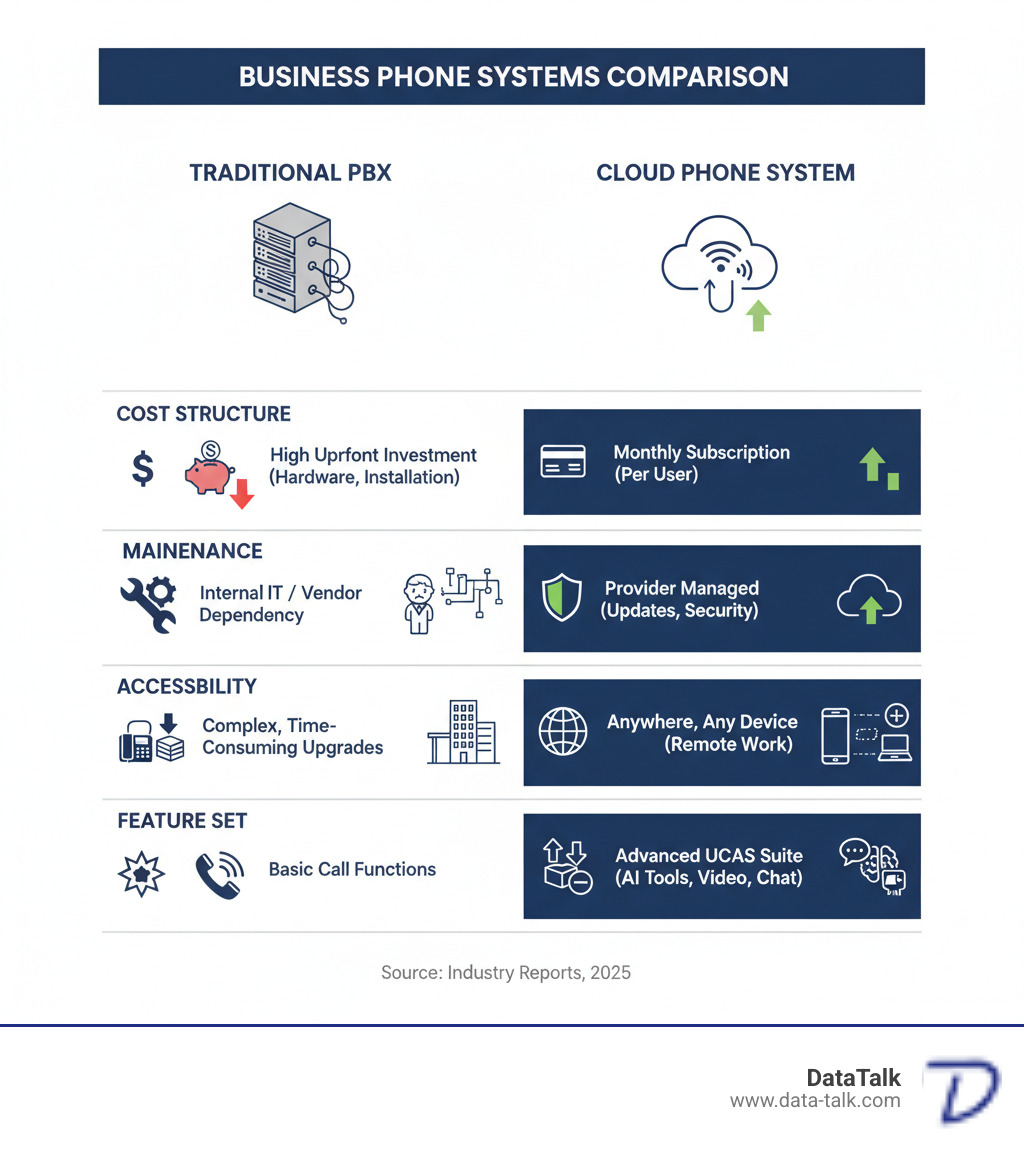
Cloud Phone Systems: Key Advantages for Modern Businesses
Making the switch to a cloud based business phone system gives your business real advantages that translate to your bottom line. For businesses across Ohio, from Columbus to Akron to Cincinnati, cloud phone systems deliver benefits that traditional on-premises setups simply can’t match.

With a cloud system, the entire infrastructure lives in your provider’s secure data centers, not your office. There’s no bulky equipment to maintain or tangled wiring to manage. Your provider handles all updates, security, and maintenance. This is a stark contrast to traditional on-premises PBX systems, where you own all the hardware and shoulder the responsibility for keeping it running. If you’re curious about the technical details, we’ve broken down the differences between hosted IP PBX and premise-based systems.
Key Benefits of a Cloud Based Business Phone System
The shift to cloud communications creates tangible improvements across your entire operation.
Cost Savings: Companies report an average 30% reduction in costs compared to traditional setups. By shifting your phone system from a large capital expense (CapEx) to a predictable operational expense (OpEx), you improve cash flow and simplify budgeting. We’ve outlined 5 specific ways cloud systems reduce costs for Ohio small businesses.
Scalability and Flexibility: Need to add fifteen employees for a new contract or scale down during a slow season? With a cloud system, you can add or remove users instantly through an online portal. Your phone system expands and contracts exactly when you need it to.
Remote Work Support: A cloud based business phone system is built for modern work. Team members can make and receive business calls from their laptops, smartphones, or desk phones, whether they’re at home in Columbus or at the office in Akron. Companies embracing this flexibility see a 25% boost in employee productivity.
Business Continuity: If your office loses power, a cloud system automatically reroutes calls to mobile phones or other locations, so your business keeps running. Many providers maintain impressive uptime records, with some achieving 99.999% availability—that’s roughly five minutes of downtime per year.
Reduced IT Burden: With a cloud provider handling the technical heavy lifting, your IT team is free to focus on strategic initiatives. Businesses report a 50% reduction in IT support costs related to telephony after making the switch.
Considerations When Moving to the Cloud
While the advantages are significant, it’s important to consider these factors before making the switch.
Internet Dependency: Your phone system runs over your internet connection, so a reliable, high-speed connection is essential. At DataTalk, we take this seriously, which is why we perform our VOIP Scout Test before deployment to guarantee your network is ready.
Bandwidth and Latency: For crystal-clear voice calls, you need sufficient bandwidth and low latency. Quality of Service (QoS) settings help prioritize voice traffic over less time-sensitive data. We’ve put together a guide covering everything Columbus entrepreneurs should know about VoIP QoS.
Security: Cloud providers invest heavily in infrastructure security, but you must secure your end of the connection by using strong passwords and managing user access.
Budgeting and Integration: While cloud systems deliver long-term savings, you may have initial costs for new IP phones or network upgrades. It’s also important to verify that the new system can integrate with your existing critical workflows.
Essential Features and Advanced Capabilities of a Cloud Based Business Phone System
Today’s cloud based business phone system is a communication powerhouse that unifies everything your team needs to work smarter. This concept, known as Unified Communications as a Service (UCaaS), brings phone calls, video meetings, and team chat into a single application, boosting efficiency and collaboration.
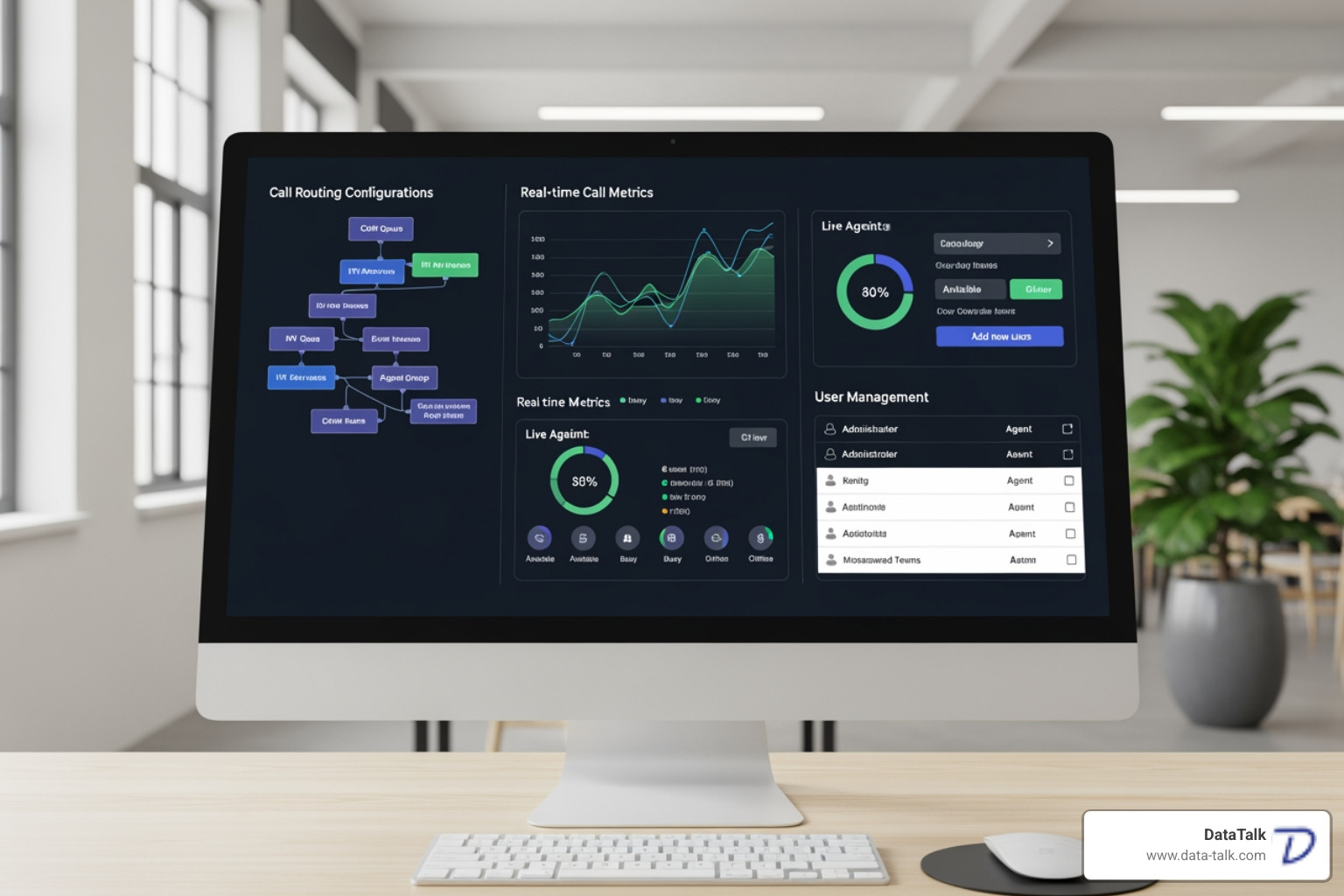
By 2027, 85% of enterprises are expected to adopt UCaaS platforms. Companies that make the switch typically see significant productivity gains, and we’ve seen this with our Columbus clients. If you’re curious about the real-world impact, check out How Unified Communications Can Make Your Company More Productive.
Core Features Every Business Needs
When we help Ohio businesses choose a system, we ensure these fundamental features are rock-solid to make daily operations run smoothly.
- Call Management: The basics that must work flawlessly, including call forwarding, call transfer (warm and blind), call waiting, and caller ID.
- Auto-Attendant: Your digital receptionist that greets callers with a custom message and routes them to the right person or department.
- Call Queues: Keeps callers on the line with music or messages until an agent is available, reducing missed calls and customer frustration.
- Visual Voicemail: Delivers voicemail transcriptions to your email or mobile app, allowing you to scan messages and prioritize callbacks.
- Mobility Features: Desktop and mobile apps that give your team full phone system functionality from anywhere, which is essential for remote and hybrid teams.
- Analytics and Reporting: Provides key data on call volume, wait times, and team performance so you can measure and improve your communication strategy.
- Numbering Options: Get local numbers in any city you do business, a toll-free 1-800 number, or a memorable vanity number.
These features work together to Boost Your Company’s Productivity with These Awesome Small Business Phone System Features.
The Power of AI and Integrations
The newest cloud based business phone system platforms are incorporating artificial intelligence and deep integrations that transform workflows.
AI integration is changing the game with features like automatic call transcription, which converts every conversation into searchable text for compliance and training. Sentiment analysis can detect the emotional tone of a call, helping managers identify customer service opportunities. AI assistants can answer common questions, route calls, and even summarize conversations.
CRM integrations with platforms like Salesforce and HubSpot create “screen pops,” instantly displaying a caller’s record on your agent’s screen. This eliminates the need for customers to repeat information and empowers your team to provide better, faster service.
Workflow automation ties everything together. After a call, the system can automatically update your CRM or create tasks in your project management software. Many providers offer robust APIs for custom development, but most businesses find the pre-built integrations handle everything they need.
Keeping up with these advancements matters. We regularly share updates about 2024 Small Business Phone System Trends so our clients stay ahead. While powerful, integrations can be tricky, which is why we’ve documented 5 Small Business Phone System Integration Issues: How to Fix Them.
How to Choose and Implement Your System

Choosing the right cloud based business phone system is about matching the solution to your specific needs. What works for a small Columbus startup might not suit a healthcare practice in Worthington or a manufacturer in Akron. Rushing a decision based on price alone can lead to missing critical features or paying for extras you’ll never use. Our Tips to Help You Choose the Best Business Phone System to Match Your Company’s Unique Needs can help guide this process.
Assessing Your Business Needs
Start by looking inward at your team size, typical call volume, and industry-specific requirements. For example, any healthcare organization in Ohio must choose a system that is HIPAA compliant to protect patient data. We’ve written about How VoIP Phone Systems Benefit Healthcare Facilities if this applies to you.
From a budget perspective, cloud systems use a predictable per-user pricing model. However, it’s wise to look at the Total Cost of Ownership (TCO). While you’ll have a monthly bill, you’ll also save on IT support, maintenance, and hardware. Businesses using cloud phone systems report a 50% reduction in IT support costs related to telephony, which is a significant long-term saving.
The Migration and Setup Process for a Cloud Based Business Phone System
Once you’ve chosen a provider, the migration process is far less disruptive than with traditional systems.
The most critical step is ensuring network readiness. Your cloud phone system’s performance depends entirely on your internet connection. This is where DataTalk takes a different approach. We perform our VOIP Scout Test—a comprehensive analysis of your network’s bandwidth, latency, and Quality of Service (QoS). We identify and fix potential problems before they become actual problems, guaranteeing your network is ready for crystal-clear calls from day one.
Number porting allows you to keep your existing phone numbers. The process typically takes one to two weeks, during which your phones continue to work without any service interruption. We handle the coordination for you.
Setup and management are handled through intuitive online portals, allowing you to configure auto-attendants, call routing, and users with a few clicks. Even so, strong provider support is crucial. Look for 24/7 availability and clear Service Level Agreements (SLAs) that guarantee uptime and response times.
For ongoing success, follow best practices for system upkeep. We’ve compiled our experience into Tips to Help You Maintain Your Company’s VoIP Business Phone System to help you avoid common pitfalls.
Frequently Asked Questions about Cloud Phone Systems
We talk with businesses across Ohio every day about making the switch to a cloud based business phone system, and many of the same questions come up. Let’s tackle the big ones. For more answers, we’ve also compiled FAQs About a Small Business Phone System.
Can I keep my existing business phone number?
Yes, absolutely. You can keep your existing business phone number when you switch to a cloud based business phone system. The process is called number porting. We coordinate with your old and new providers to ensure a smooth transfer. The process typically takes one to two weeks, and your phone service continues uninterrupted the entire time. Your team in Clintonville or Worthington won’t miss a single call.
How much does a cloud based business phone system typically cost?
Cloud systems operate on a transparent subscription model, typically charging per user, per month. This makes budgeting predictable. Most providers offer tiered pricing:
- Basic plans ($15-$25/user/month): Cover essential calling features.
- Mid-tier plans ($25-$35/user/month): Add video conferencing, team messaging, and analytics.
- Premium plans ($35-$50/user/month): Include advanced CRM integrations, AI features, and improved security.
Your final cost depends on your number of users and selected features. While you can use computers and smartphones as phones (softphones), many businesses purchase physical IP desk phones, which are an additional one-time cost ($75-$300 each).
How secure are cloud phone systems?
Reputable cloud based business phone system providers offer security that most small businesses can’t match on their own. Security is a multi-layered effort:
- Provider Infrastructure: The provider is responsible for securing the physical data centers with biometric access, 24/7 surveillance, and redundant power.
- Data Encryption: Voice traffic is protected using encryption standards like TLS and SRTP, which scramble call data to make it unreadable if intercepted.
- Compliance: Top providers maintain certifications like SOC2 and HIPAA to prove they adhere to strict security and data privacy protocols.
Security is a partnership. While your provider secures the cloud, you are responsible for securing your local network and devices with strong passwords, multi-factor authentication, and employee training. For a deeper dive, read our guide: Is Your VoIP Phone System Secure?. Most Ohio businesses find they are more secure with a cloud system than they were managing their own on-premises equipment.
Conclusion: Future-Proof Your Business Communications
The shift to a cloud based business phone system isn’t just about keeping up with technology—it’s about positioning your business for long-term success. Throughout this guide, we’ve explored how these systems deliver real, measurable advantages: 30% average cost savings compared to traditional systems, 25% productivity increases for your team, and the flexibility to support modern work styles that today’s employees expect.
Think about what this means for your business in Columbus, Akron, Cincinnati, or anywhere across Ohio. You’re no longer tied to expensive hardware that depreciates and becomes obsolete. You’re not scrambling to find technicians who can maintain aging PBX systems. Instead, you have a communication platform that grows with you, supports your team wherever they work, and keeps your business running even during unexpected disruptions.
The advanced capabilities we’ve discussed—AI-powered transcriptions, seamless CRM integrations, intelligent call routing, and unified communications—aren’t futuristic concepts. They’re available today, changing how businesses interact with customers and how teams collaborate. These features create efficiencies that directly impact your bottom line and customer satisfaction.
We know the transition can feel daunting. Questions about internet reliability, call quality, and security are valid concerns. That’s exactly why we developed our VOIP Scout Test—to eliminate the guesswork and ensure your network is truly ready before you make the switch. We don’t believe in surprises. We believe in thorough preparation that guarantees crystal-clear calls from day one.
The future of business communications is already here, and it’s in the cloud. Traditional phone lines are being phased out, and by 2026, three-quarters of small and mid-sized businesses will have made the move. The businesses that transition strategically—with proper planning, network assessment, and expert guidance—will be the ones that thrive.
Your business deserves a phone system that works as hard as you do. One that saves you money, empowers your team, and grows with your ambitions. Whether you’re ready to make the switch today or still gathering information, we’re here to help you every step of the way.
Get expert guidance on the right VoIP phone service for your Columbus, Ohio business.