Unifying Your Communications: Finding the Right Business Phone System in Columbus

Why Columbus Businesses Need Modern VoIP Phone Solutions


Voip phone service columbus ohio is changing how local businesses communicate. If you’re looking for a modern phone system that cuts costs, supports remote teams, and delivers enterprise features without the enterprise price tag, VoIP is your answer.

Traditional phone systems are holding Columbus businesses back. You’re paying more for less—expensive hardware, limited features, and no flexibility for remote work. Meanwhile, your competitors are cutting phone bills by up to 70% while adding capabilities like HD video calling, SMS messaging, and seamless mobile integration.

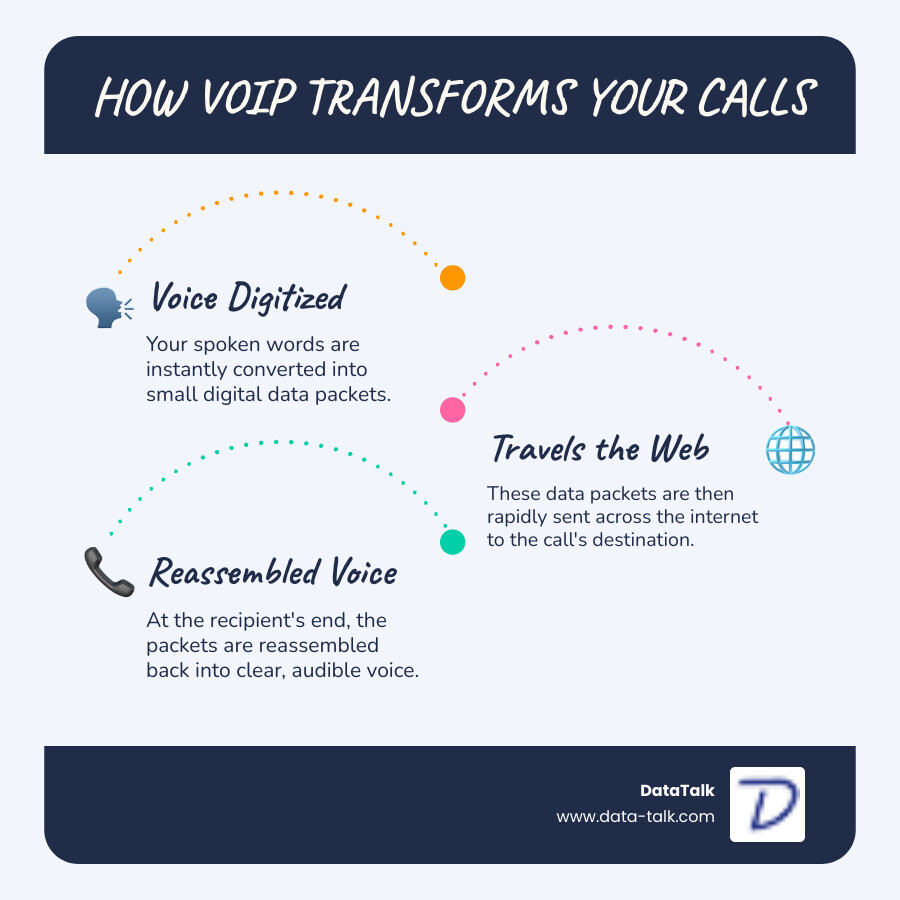
VoIP works by converting your voice into digital data packets that travel over your existing internet connection. This simple shift eliminates costly phone lines and opens the door to features that were once only available to Fortune 500 companies. Now, even a small startup in the Short North can access the same communication tools as a large firm in Easton.

However, there’s a catch: not all internet connections are ready for business-grade voice quality. A poor network setup leads to dropped calls, robotic voices, and frustrated customers. That’s why network readiness testing—checking for adequate bandwidth, low latency, and proper Quality of Service (QoS) configuration—is a critical step when switching to VoIP in Columbus.

As one local business owner put it: “Part of our motivation for a new phone system was to capture the capabilities of a modern system.” That’s exactly what VoIP delivers when implemented correctly.
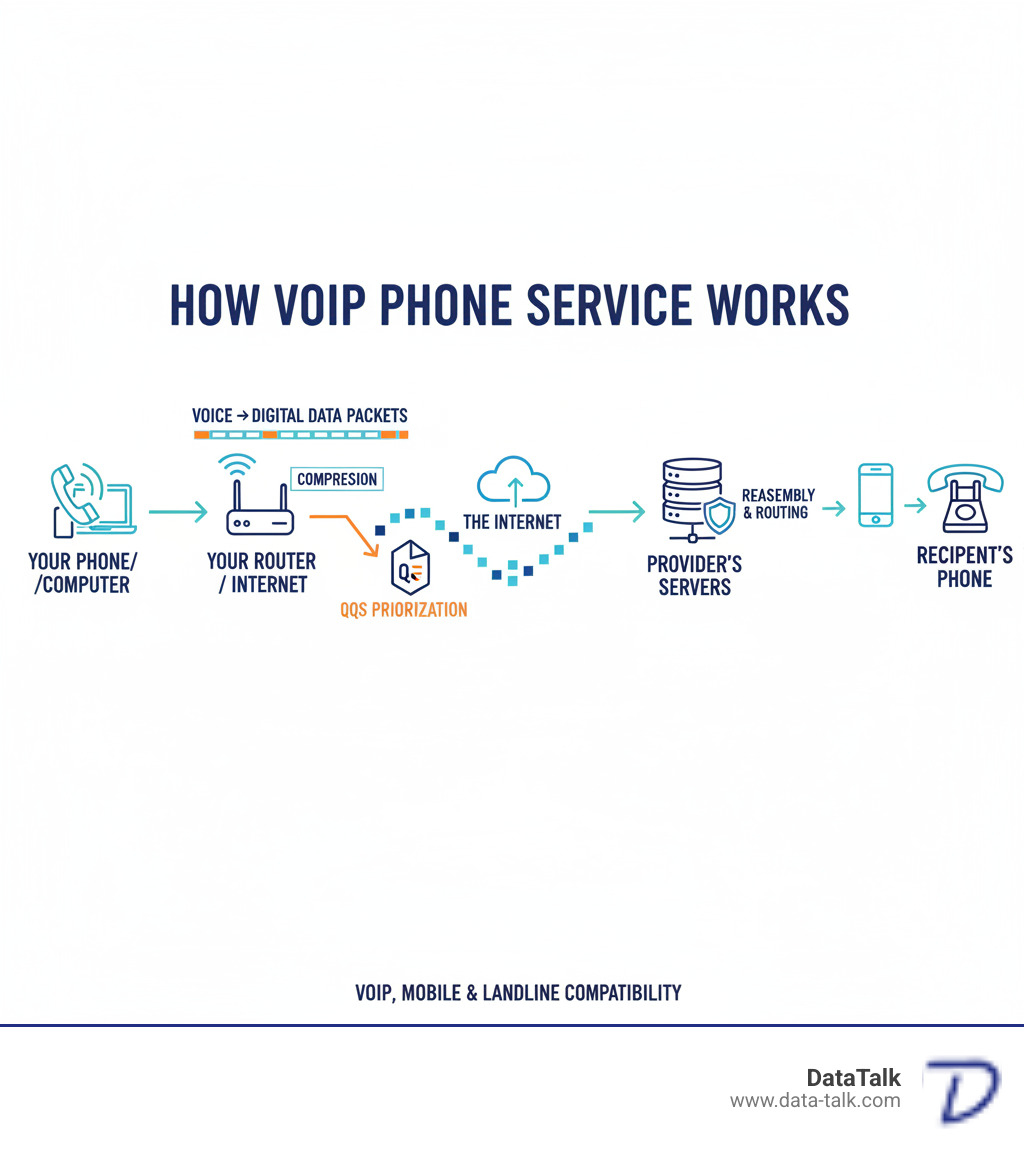
Infographic showing how VoIP phone service works: voice is converted into digital data packets at your phone or computer, packets are compressed and sent over your internet connection through your router, packets travel through the internet to your provider's servers, and are reassembled and routed to the recipient's phone whether it's another VoIP phone, mobile device, or traditional landline. The diagram includes icons showing Quality of Service prioritization ensuring voice packets get bandwidth priority over other data traffic. - voip phone service columbus ohio infographic

Why Columbus Businesses are Switching to VoIP Phone Services

Something fundamental is shifting in how Columbus businesses handle their phone systems. More companies are finding that voip phone service columbus ohio isn’t just a tech upgrade—it’s a complete rethinking of how communication should work in 2025.

The driving force? Real dollars saved and real problems solved. Traditional phone systems require expensive hardware and dedicated phone lines. VoIP flips that model by using your existing internet connection, which means fewer lines, less equipment, and dramatically lower monthly bills. Some Columbus businesses are saving up to $18,000 annually by making the switch.

Beyond cost savings, what really makes VoIP compelling is how it grows with you. Whether you’re a three-person startup in the Short North or a 200-employee operation in Easton, VoIP adapts. Need to add five people for the holiday rush? Done in minutes. Traditional phone systems require service calls and weeks of planning; VoIP requires a few clicks.

This flexibility is essential for the modern workplace. With cloud-based VoIP, your phone number follows you wherever you have internet access. Your team can work from home, client sites, or a coffee shop in German Village—and the phone system doesn’t care. One professional services firm maintained 100% client satisfaction while their entire team went remote, all because their unified VoIP platform kept everyone connected.

The local angle matters too. A 380 area code signals you’re part of the community, not some faceless national operation. One local real estate group reported a 25% increase in qualified leads after switching to local VoIP numbers with SMS confirmations.

The shift to voip phone service columbus ohio isn’t just about keeping up with technology. It’s about removing barriers between you and your customers, between you and growth, between where your business is and where it could be.

Want to understand exactly why Columbus businesses are making this move right now? We’ve written a detailed breakdown at Why Columbus, Ohio Businesses Are Switching to Cloud Voice in 2025.

Chart showing the comparison of typical monthly costs for traditional phone systems vs. VoIP phone systems, highlighting significant savings in hardware, maintenance, and per-user costs for VoIP over a 3-5 year period. - voip phone service columbus ohio

Essential Features of a Modern Business Phone System

Today’s Columbus businesses need communication tools that actively improve workflows. A modern VoIP phone service Columbus Ohio delivers an intelligent, integrated experience through a suite of powerful features.
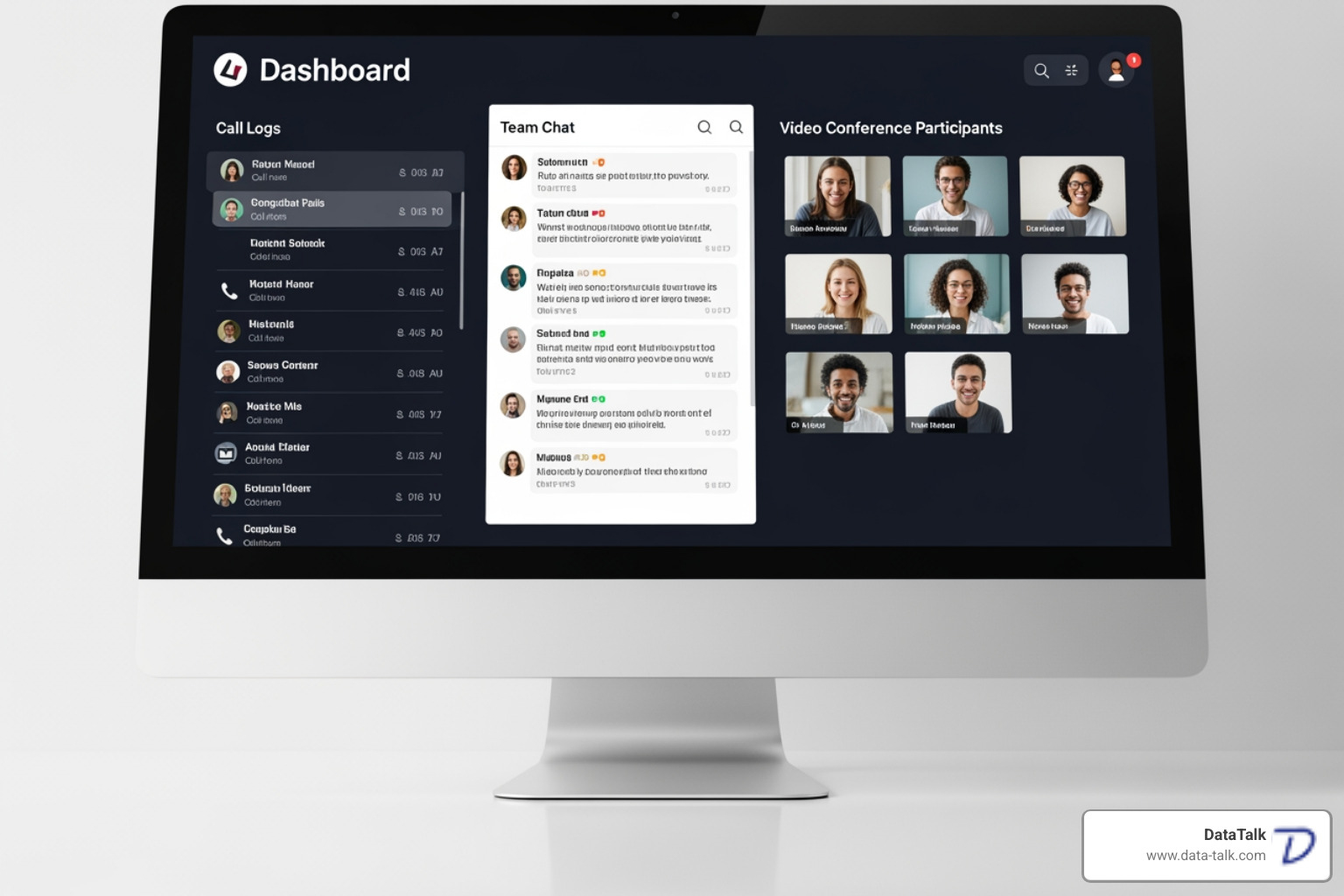
Unified communications dashboard on a computer screen displaying call logs, team chat, and video conference options. - voip phone service columbus ohio

Unified Communications (UCaaS) is the foundation, bringing together phone calls, chat, and video meetings into one cohesive platform. This eliminates the need to juggle separate apps, allowing your team to collaborate more efficiently from a single hub.

Key features that transform daily operations include:

  • Intelligent Call Routing & Auto-Attendant: Automatically guide callers to the right person or department with custom menus (“Press 1 for Sales”). This frees up staff and ensures customers get help faster.
  • Mobility and Forwarding: Features like Find Me/Follow Me forward calls from your desk to your mobile, ensuring you never miss an important call, no matter where you are.
  • Voicemail-to-Email: Receive voicemails as audio files in your inbox, allowing you to listen, forward, or archive messages with a single click.
  • Call Recording: Essential for quality assurance and training, modern systems allow you to record calls, review them with staff, and even provide live coaching.
  • CRM & Teams Integration: Connect your phone system to tools like Salesforce, HubSpot, or Microsoft Teams. This enables screen pops with customer history on incoming calls and allows you to make business calls directly from the apps you use every day.
  • Business SMS/MMS: Communicate with customers via text for appointment reminders, order confirmations, and support follow-ups, which many customers prefer.

These capabilities work together to create a communication ecosystem that adapts to how your business actually operates. To explore the complete range of what’s possible with modern VoIP, visit our page on VoIP System Features.

Choosing the Best VoIP Phone Service in Columbus Ohio

Selecting the right VoIP phone service Columbus Ohio is about finding a partner who understands your business and supports your growth. The decision will shape your team’s communication and your customers’ experience.

Start by assessing your current frustrations and future needs. Then, consider your budget. VoIP is designed to save you money, but look for transparent, predictable pricing that scales with your business. Most importantly, evaluate the provider’s reputation and customer support. You need a local expert who can provide swift problem resolution and ongoing optimization, not just a vendor who disappears after the sale.

For more detailed guidance on making this crucial decision, explore our 5 Tips on Choosing a Telecom Provider for Your Business.

The Critical Role of Network Readiness and QoS

Your VoIP service is only as good as the internet connection running it. Without a properly configured network, you’ll experience dropped calls and choppy audio. This is where Quality of Service (QoS) becomes critical. QoS prioritizes voice data to ensure it isn’t competing with less time-sensitive traffic, like file downloads.

Factors like latency (delay), packet loss (missing audio), and jitter (choppy sound) can ruin call quality. That’s why we insist on a comprehensive network assessment before any deployment. Our proprietary VOIP Scout Test evaluates your network’s actual capability to support VoIP by measuring these crucial parameters. This proactive approach guarantees excellent voice quality from day one. Often, the foundation for this is robust structured cabling, which we also provide.

For a deeper dive into maintaining optimal call quality, check out Everything Columbus, Ohio Entrepreneurs Should Know About VoIP QoS.

Tailoring a voip phone service columbus ohio for Key Local Industries

A great VoIP service should be custom to your industry’s specific challenges.

  • Healthcare: HIPAA-ready controls, secure voicemail, and intelligent routing for appointments or billing can protect patient privacy and reduce hold times.
  • Real Estate: Neighborhood-specific local numbers and instant lead routing help agents respond faster and capture more opportunities.
  • Professional Services: CRM integration automatically logs billable hours and client interactions, improving accuracy and efficiency.
  • Retail & Hospitality: SMS notifications for reservations or order updates can reduce no-shows and improve the customer experience.
  • Home Services: Automated SMS arrival windows and intelligent dispatching can cut down on missed appointments and repeat scheduling calls.

For more insights into how VoIP benefits specific industries, particularly in healthcare settings, read How VoIP Phone Systems Benefit Healthcare Facilities.

Understanding Security Best Practices for your voip phone service columbus ohio

Moving your phone system to the cloud requires a focus on security. Key practices include:

  • Encryption: Ensure your provider offers end-to-end encryption to keep conversations private.
  • Secure Voicemail: Protect confidential information with strong password requirements and encrypted storage.
  • Spam Call Blocking: Use robust filtering to block robocalls and potential phishing attempts before they waste your team’s time.
  • Improved 911 (E911) Services: Your VoIP system must accurately report your location during an emergency. This is a critical safety feature, especially for remote workers. You can learn more about this from the FCC’s guide on VoIP and 911 service.
  • User Training & Compliance: Train your team on secure practices and use role-based access controls to minimize risk. For regulated industries, ensure your system meets standards like HIPAA.

For a comprehensive look at protecting your business phone system, read Is Your VoIP Phone System Secure?

Frequently Asked Questions about Business VoIP in Columbus

Switching to a new communication system naturally brings up questions. Here are clear, straightforward answers about VoIP phone service Columbus Ohio.

How much does a business VoIP system cost compared to a traditional one?

VoIP is typically significantly more cost-effective. You save money by eliminating hefty upfront hardware investments, reducing monthly bills by using your existing internet connection, and cutting out maintenance contracts. Most providers offer predictable per-user pricing, so you only pay for what you need. A retail chain, for example, saved over $18,000 annually by switching to a cloud-based VoIP solution.

For more insights into how a modern phone system can benefit your budget, check out 5 Ways a New Phone System Can Save Your Dublin, OH Business Money.

How long does it take to switch to a VoIP system?

Unlike traditional systems that took weeks to install, a modern VoIP system can be up and running in hours, not days. In many cases, setup takes just 24–48 hours. Because the system is cloud-based, there is no extensive on-site hardware installation. We can configure your system and users remotely, ensuring a fast and smooth transition with zero downtime.

Can I keep my existing Columbus business phone number?

Absolutely. Your phone number is part of your brand, and you can keep it. Through a federally regulated process called Local Number Portability (LNP), we can transfer your existing number from your old carrier to your new VoIP service. The process is seamless, with no disruption to your clients. They keep calling the same number, and you keep answering.

Conclusion: Unify Your Columbus Business with a Future-Ready Phone System

Columbus, Ohio skyline at dusk with city lights reflecting on the river. - voip phone service columbus ohio

If there’s one clear takeaway, it’s this: VoIP phone service Columbus Ohio is essential for any local business that wants to thrive. It slashes phone bills, enables remote teams, and provides advanced features that traditional systems can’t match. You can scale effortlessly and delight customers with better service.

But not every VoIP system is created equal, and not every network is ready for business-grade voice. That’s where having the right local partner makes all the difference. At DataTalk, we don’t just sell you a phone system. We start with our proprietary VOIP Scout Test, a comprehensive network readiness assessment that guarantees crystal-clear call quality from day one.

We customize solutions that fit your specific needs and budget, backed by structured cabling expertise and a genuine commitment to your success. The future of business communication is here, and your competitors aren’t waiting. Why should you?

Ready to transform how your Columbus business communicates? Let’s start the conversation. Visit our page to Explore VoIP Phone Service Providers in Columbus, Ohio and find how a modern, future-ready phone system can give your business the competitive edge it deserves.
The Ultimate Guide to Cloud-Based Phone Systems

The Future of Business Communication is in the Cloud


A Cloud IP PBX is a virtual phone system that operates over the internet, replacing bulky, on-premise hardware. It lives in secure data centers, delivering calls and advanced features through your internet connection—perfect for modern businesses needing flexibility and reliability without the hassle of managing equipment.

Quick Answer: What You Need to Know About Cloud IP PBX

What It Is What It Does Why It Matters
Internet-based phone system Routes calls through the cloud using VoIP technology No expensive hardware to buy or maintain
Hosted by service providers Delivers enterprise features via subscription Works from anywhere with internet
Replaces traditional PBX Handles all your business calling needs Scales easily as you grow

Many small business owners in Ohio struggle with outdated phone systems that are unreliable and expensive to maintain. The telecommunications industry is rapidly changing, with traditional systems becoming obsolete. The hosted PBX market is expected to grow 15.5% by 2030, and small businesses are a driving force in the VoIP market’s projected growth.

This shift is happening because cloud-based systems solve real problems: they cost less upfront, work from anywhere, and include advanced features without expensive upgrades. With 99.99% uptime guarantees, modern cloud systems are often more reliable than traditional phone lines.

The challenge isn’t knowing that you need to upgrade—it’s understanding how these systems work and if your network can handle it. This guide will explain everything you need to know.

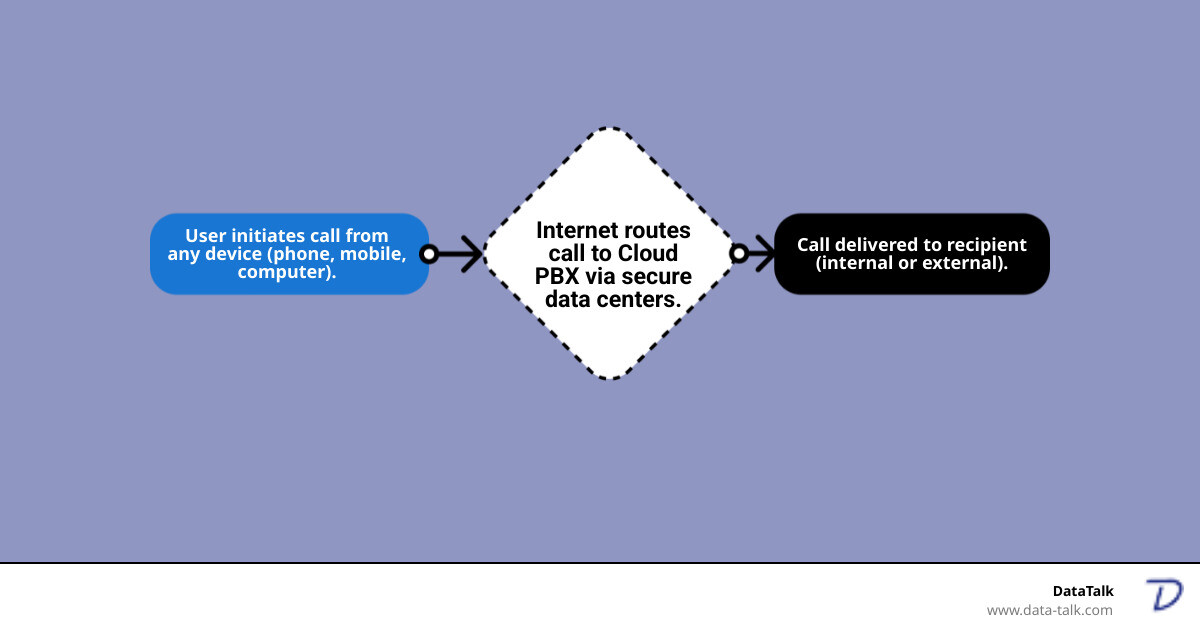
Infographic showing how a cloud IP PBX routes business calls over the internet through secure data centers to any device (desk phone, mobile, computer), compared to a traditional PBX which routes calls through physical phone lines and on-premise hardware boxes - cloud ip pbx infographic flowmap_simple

What is a Cloud PBX and How Does It Work?

A cloud IP PBX represents a fundamental shift in business communications, moving your phone system from a closet to the cloud.

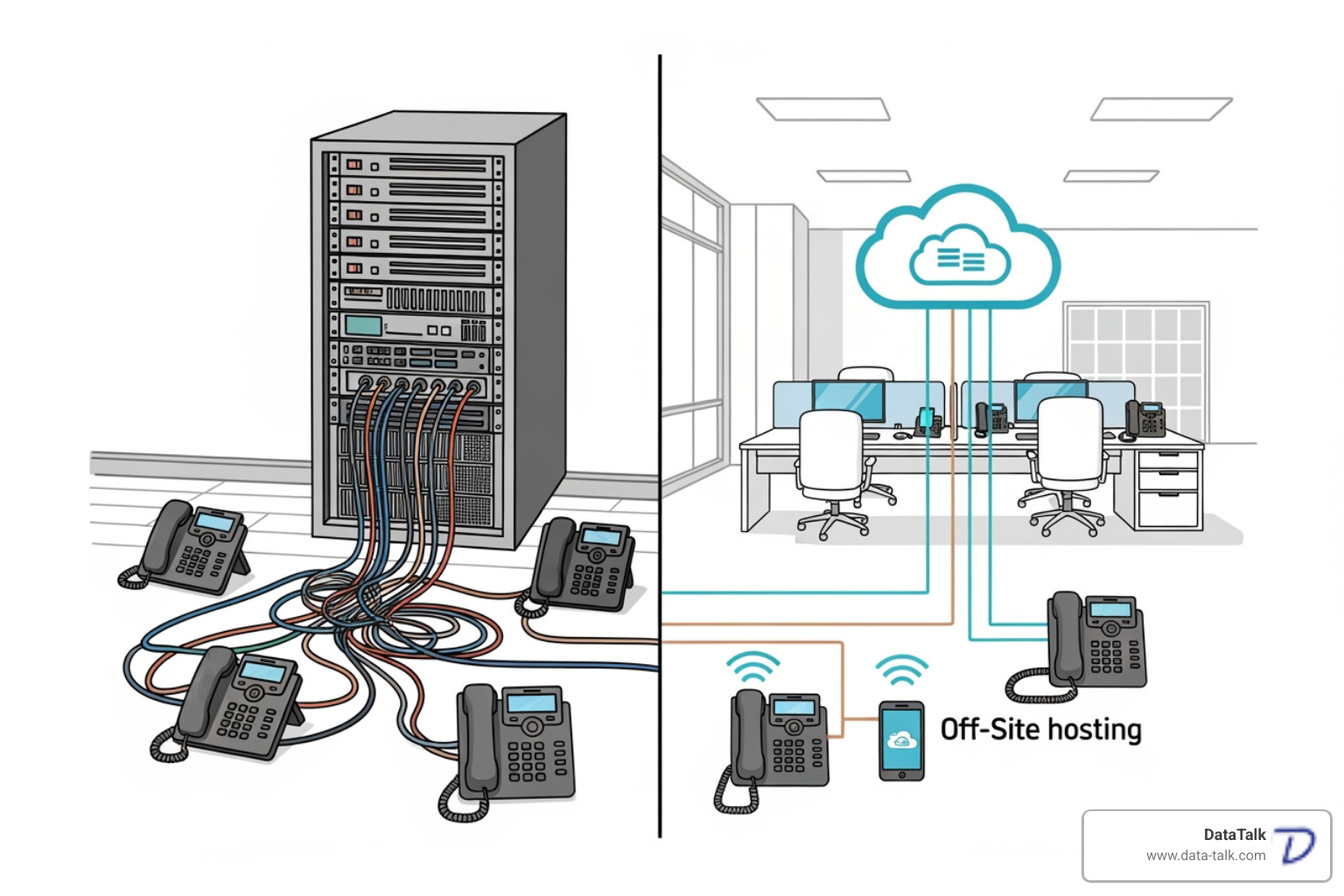
Diagram comparing a traditional on-premise PBX setup with a cloud PBX setup - cloud ip pbx

PBX stands for Private Branch Exchange, which is your company’s private telephone network. For decades, a PBX was a physical switchboard that managed calls. The internet changed everything with Voice over Internet Protocol (VoIP), which sends your voice as digital data online. For general background, see Private branch exchange and Voice over IP.

A cloud IP PBX moves the entire PBX system into secure, remote data centers managed by a service provider. All equipment, software updates, and maintenance are handled off-site by experts. When you make a call, your voice travels over the internet to the provider’s data center, which routes the call and manages features. You can use desk phones, computer softphones, or mobile apps to make and receive calls from anywhere with an internet connection.

SIP Trunking is the digital equivalent of traditional phone lines, allowing your internet connection to carry multiple calls at once, making the system efficient and flexible. Your provider manages the complex infrastructure, so you can enjoy a sophisticated phone system without the maintenance headaches. For more details, see our guide on Hosted IP PBX vs. Premise-Based IP PBX: What’s the Difference?, and learn more about the concept in SIP trunking.

Traditional PBX vs. Cloud PBX

The difference between old and new phone systems is stark. Traditional PBX systems require a massive upfront hardware cost and create an ongoing maintenance burden, often needing dedicated IT staff. Scalability is limited and expensive, requiring new hardware for new lines. These systems are also tied to a single physical location, a major drawback for modern businesses.

A cloud IP PBX flips this model:

  • No Hardware Costs: Your upfront investment is minimal because you’re not buying expensive on-site equipment.
  • Zero Maintenance: The provider handles all maintenance, upgrades, and security.
  • Effortless Scalability: Add or remove users in minutes through a web portal. Your system grows with your business.
  • Location Independence: Your team can work from anywhere with an internet connection.

The subscription model of cloud calling offers predictable monthly costs, eliminating surprise repair bills. For a deeper look, our article on Hosted IP PBX vs. Premise-Based IP PBX breaks it down.

The Technology Behind Cloud-Based Calling

VoIP technology is the foundation. It converts your voice into digital data packets that travel across the internet. This process, called packet switching, breaks your voice into pieces, sends them along the most efficient route, and reassembles them at the other end. Learn more in our guide on What’s Cloud Calling and How Does It Work?.

Codecs (algorithms that compress and decompress voice data) balance audio quality with bandwidth use. Your internet connection is crucial, as each call needs about 80-100 kbps of bandwidth. More importantly, Quality of Service (QoS) settings prioritize voice traffic to ensure calls remain clear, even when your network is busy.

While related, WiFi Calling vs. VoIP Calling are different. WiFi Calling is a mobile carrier feature for weak cell signal areas, whereas a VoIP system is a complete business communication platform. We explain this in our article on WiFi Calling vs. VoIP Calling.

For more technical details, explore the Differences Between SIP PBX & VoIP Phone Systems and the Difference Between VoIP Technology & SIP Trunking.

The Transformative Benefits of a Cloud IP PBX

Switching to a cloud IP PBX is about more than new phones—it’s about fundamentally improving how your business operates, communicates, and grows.

Chart showing cost savings over time with a cloud PBX - cloud ip pbx

The hosted PBX market is expected to grow 15.5% by 2030, and small businesses are a key part of this trend. The reason is clear: the benefits are tangible.

Consider business continuity. With a traditional system, an office power outage means your phones are dead. With a cloud IP PBX, the system lives in the cloud. If your office has an issue, calls automatically route to mobile phones or other locations, so you never miss a call. This resilience is backed by a 99.99% uptime guarantee from most providers, which often exceeds the reliability of traditional phone lines.

These disaster recovery benefits provide peace of mind, making your phone system one less thing to worry about. For small businesses in Columbus, this reliability is essential. Explore more advantages in Why Small Businesses Need VoIP Phone Systems and the Benefits of VoIP for Remote Working.

Significant Cost Savings for Your Business

Switching to a cloud IP PBX saves you money in several key ways. The most obvious is the elimination of capital expenditure. There’s no expensive on-site PBX hardware to buy, freeing up cash for business growth.

Operational costs also drop significantly. You no longer pay for maintenance contracts, emergency repairs, or the IT hours spent managing a legacy phone system. Your provider handles all of this as part of your subscription.

Business owners also appreciate the predictable monthly billing. A cloud PBX system typically costs between $120 and $300 per year per user on average. This clear pricing makes budgeting simple, with no surprise bills for repairs or upgrades. For businesses in Dublin and Hilliard, these savings add up quickly. See how local businesses are benefiting in our guides on saving money in Dublin, OH and reducing costs for Hilliard, OH businesses.

Best Scalability and Flexibility

A cloud IP PBX grows with your business effortlessly. Forget buying capacity you don’t need or facing expensive upgrades when you outgrow your system.

With a cloud system, adding a new employee takes minutes. Simply log into your online portal and add a user—no technician or new wiring required. This flexibility works both ways; you can scale down during slower periods and stop paying for unused lines. This grow-as-you-go model ensures you only pay for what you need.

This flexibility extends to multiple locations. Offices in Columbus, Cincinnati, and Akron can all operate on one unified system with free inter-office calls. A receptionist in one city can seamlessly transfer a call to a team member in another.

This scalability is invaluable for businesses planning for growth, managing seasonal demand, or expanding to new markets without major infrastructure investments. Learn more in Five Strategies to Make Your Business More Scalable in 2024 and Scaling Your Hilliard Business With Hosted VoIP.

Essential Features and Integration Capabilities

A cloud IP PBX is a complete communication hub, bringing together voice, video, and messaging. This approach, known as Unified Communications as a Service (UCaaS), is designed to make your team more productive. It enables omnichannel communication, allowing customers to reach you by phone, text, or chat, and your team to respond from any device.

These robust features are designed to Boost Your Company’s Productivity.

Key Cloud PBX Features

Let’s review the features that make a cloud IP PBX a game-changer:

  • Auto-Attendant: Your virtual receptionist greets callers and directs them to the right person or department, ensuring no call is missed.
  • Interactive Voice Response (IVR): Lets callers use their keypad or voice to get information like business hours or account balances, freeing up your staff. Learn more about what business owners should know about IVR systems.
  • Call Queuing & Routing: Places callers in a queue during busy times instead of giving a busy signal. Calls are routed based on availability, department, or other rules. Explore this feature in our guide to call queuing.
  • Voicemail-to-Email: Delivers voicemails as audio files and transcriptions directly to your email inbox.
  • Call Recording: Essential for training, quality control, and compliance. Find the valuable ways call recording can benefit your business and why it’s necessary for call centers.
  • Video Conferencing: Built-in for face-to-face meetings with team members or clients, without needing separate software.
  • Business Texting (SMS/MMS): Allows you to send and receive texts from your business phone numbers, a preferred method for many customers. Learn how to leverage text messaging in your business.

Integrating Your Cloud IP PBX with Business Tools

A modern cloud IP PBX connects with the other software your business relies on, creating seamless workflows.

Integrating with CRM platforms like Salesforce, Zoho, or HubSpot allows customer records to pop up on-screen during a call, providing your team with complete context for personalized service. Our guide to VoIP CRM integration shows you how.

Helpdesk software integration can automatically create support tickets from incoming calls, attaching call recordings for full context.

Microsoft 365 and Google Workspace integrations bring communication into the tools your team uses daily, allowing for click-to-call and presence status visibility without switching apps.

For unique needs, many providers offer APIs for custom applications, letting you embed communication features directly into your proprietary software. These integrations turn your phone system into a central hub that ties all your business tools together.

Empowering Modern Workforces and Ensuring Security

Remote and hybrid work are the new normal, and a phone system that can’t support a distributed team is a liability. A cloud IP PBX is built for this new era of work, connecting your employees wherever they have an internet connection.

Employee working from home using a softphone on a laptop - cloud ip pbx

Mobile apps and softphones (software for your computer) make this flexibility possible. Your team can take calls on their business line from a client site, their home office, or on the road. Everyone stays connected, and your customers receive seamless service.

This flexible approach is one of the key benefits of VoIP for remote work that businesses across Ohio are embracing.

Supporting Distributed Teams and Remote Work

With a cloud IP PBX, your employees get true work-from-anywhere flexibility. They can use their business extension on a laptop, desktop, or mobile device.

Team members can see each other’s unified presence status (available, on a call, etc.), which eliminates phone tag and improves efficiency. Seamless call transfer works between employees regardless of their location, so a receptionist in Columbus can easily transfer a call to a technician in Grove City.

Many businesses are also adopting BYOD (Bring Your Own Device) policies. A cloud PBX app allows employees to use their personal smartphones for work calls while keeping business and personal communications separate. It’s worth weighing the pros and cons of BYOD.

These features are specifically designed to support modern work arrangements. For a deeper dive, see our guide on telephony features that support remote work teams.

Security Advantages of a Cloud IP PBX

When moving communications to the internet, security is a natural concern. However, a cloud IP PBX from a reputable provider often delivers better security than a traditional on-premise system.

Your provider invests millions in provider-managed security, including enterprise-grade firewalls, intrusion detection, and 24/7 monitoring by security experts—a level of protection most small businesses cannot afford on their own.

Key security features include:

  • Encryption: Calls are protected using TLS and SRTP, which scramble the data to prevent eavesdropping.
  • Redundant Data Centers: Geographically dispersed and physically secured facilities ensure your service stays online even if one location has an issue.
  • Session Border Controllers (SBCs): These act as specialized security guards for VoIP communications, protecting against attacks and ensuring call quality.
  • Two-Factor Authentication (2FA): Adds an extra layer of security to prevent unauthorized access to your system’s administrative settings.

Security updates and patches are applied automatically by your provider, protecting you from the latest threats without any effort on your part. For businesses concerned about security, learn more about protecting your Dublin business communications and how to protect your VoIP phone system. Before choosing a provider, always ask: Is your VoIP service secure?

How to Choose the Right Solution for Your Business

Choosing the right cloud IP PBX is about finding a partner who understands your current needs and can support your future growth. Start by assessing your business: How many users do you have? What are your biggest communication pain points? Are you planning to grow or add remote team members?

While budget is important, look beyond the monthly cost per user. Consider the savings from eliminating maintenance fees, hardware costs, and surprise repair bills. Our tips for choosing the best business phone system can walk you through this process.

Evaluating Providers and Platforms

When evaluating providers, don’t just focus on price. A good hosted cloud IP PBX provider should offer a solid Service Level Agreement (SLA). This is a contract that guarantees uptime (typically 99.99%), sets performance standards, and defines compensation if those promises aren’t met. It’s an insurance policy for your phone system.

Customer support is also critical. When issues arise, you need fast access to knowledgeable technicians. Ask potential providers about their support hours, response times, and escalation procedures. For business owners in Grove City and Central Ohio, we’ve compiled top questions to ask before signing a telecom contract to help you make a confident decision.

Crucially, your internet connection can make or break your VoIP experience. That’s why we created our VOIP Scout Test. This network readiness assessment checks your infrastructure before you switch, guaranteeing your new cloud IP PBX will deliver optimal voice quality. We identify and fix potential issues upfront, ensuring a smooth deployment from day one.

The Future of Business Communications

The cloud IP PBX systems of today are just the beginning. Artificial Intelligence (AI) is becoming a business reality, powering features like voicemail transcription, call sentiment analysis, and post-call summaries. These tools help your team work smarter.

Integrations will continue to deepen, creating a world where voice, video, text, and business apps work together seamlessly. We’re also seeing a rise in CPaaS (Communications Platform as a Service), which lets businesses embed communication features directly into their own applications.

These are not distant dreams; they are part of the latest tech advancements in cloud telephony happening now. With a modern cloud system, these new capabilities are rolled out automatically, ensuring your phone system evolves with your business.

Frequently Asked Questions about Cloud Phone Systems

Many business owners in Columbus and throughout Ohio are curious about switching to a cloud IP PBX. Here are answers to the most common questions we hear.

What does PBX stand for?

PBX stands for Private Branch Exchange. It’s your company’s private telephone network that manages both internal calls between employees and external calls. In the past, a PBX was a large, physical box in an office. Today, a cloud IP PBX does the same job, but it’s a virtual system hosted in secure data centers and delivered over the internet. You can learn more about our approach to PBX Business Phone Systems, and see a general overview in Private branch exchange.

Can I keep my existing business phone numbers?

Yes, absolutely. You can keep your existing phone numbers when you switch to a cloud IP PBX. The process is called number porting and is regulated by the FCC. Your new provider, like DataTalk, handles the entire process of transferring your numbers from your old carrier. We manage this carefully to ensure a smooth transition with minimal service disruption, so your customers can keep calling the numbers they already know. For more information, see the FCC’s guide on porting: keeping your phone number when changing service providers.

What kind of internet connection do I need?

This is a critical question. A cloud IP PBX requires a stable, high-quality internet connection for clear calls. While each call only uses about 80-100 kbps of bandwidth, raw speed isn’t the only factor. Voice quality depends on low latency (delay) and low jitter (variation in delay). High latency or jitter can cause choppy audio and dropped words.

This is precisely why we developed the VOIP Scout Test. Before deploying your new system, we run comprehensive tests on your network to measure packet loss, latency, and jitter. This allows us to identify and address any potential issues before you go live, guaranteeing your system delivers professional-quality calls from day one. Understanding and solving the issue of packet loss is key to a successful VoIP deployment.

Make the Switch to a Modern Phone System

The business communication landscape has changed. Relying on an outdated phone system holds your business back. A cloud IP PBX is the practical foundation modern businesses need to stay competitive, connected, and ready for growth.

Making the switch delivers tangible benefits: cost savings that free up capital, scalability that adapts to your team’s size with a few clicks, and improved features like auto-attendants and CRM integrations that boost productivity. These are the tools that separate thriving businesses from those struggling to keep up.

For businesses across Columbus, Akron, Cincinnati, and the surrounding Ohio communities, the opportunity is clear. Whether you’re dealing with expensive maintenance, supporting a remote team, or simply paying too much for too little, a cloud IP PBX is the solution.

At DataTalk, we specialize in helping Ohio businesses make this transition. We’re a local company that understands the needs of our community, and we design custom cloud/VoIP phone systems to fit your specific requirements.

What truly sets us apart is our exclusive VOIP Scout Test. We guarantee your network is ready for optimal voice quality before deployment. We test, identify, and fix any potential issues proactively. No surprises, no choppy calls—just a system that works perfectly from your very first call.

Don’t let another month go by with a phone system that costs too much and does too little. Your team, your customers, and your business deserve a communication system built for today’s world.

Ready to explore what a modern phone system can do for your business? We’d love to show you.

Discover Your Cloud Phone System Options

Beginner’s Guide to PoE Phone Systems

Simplifying Your Office Communications


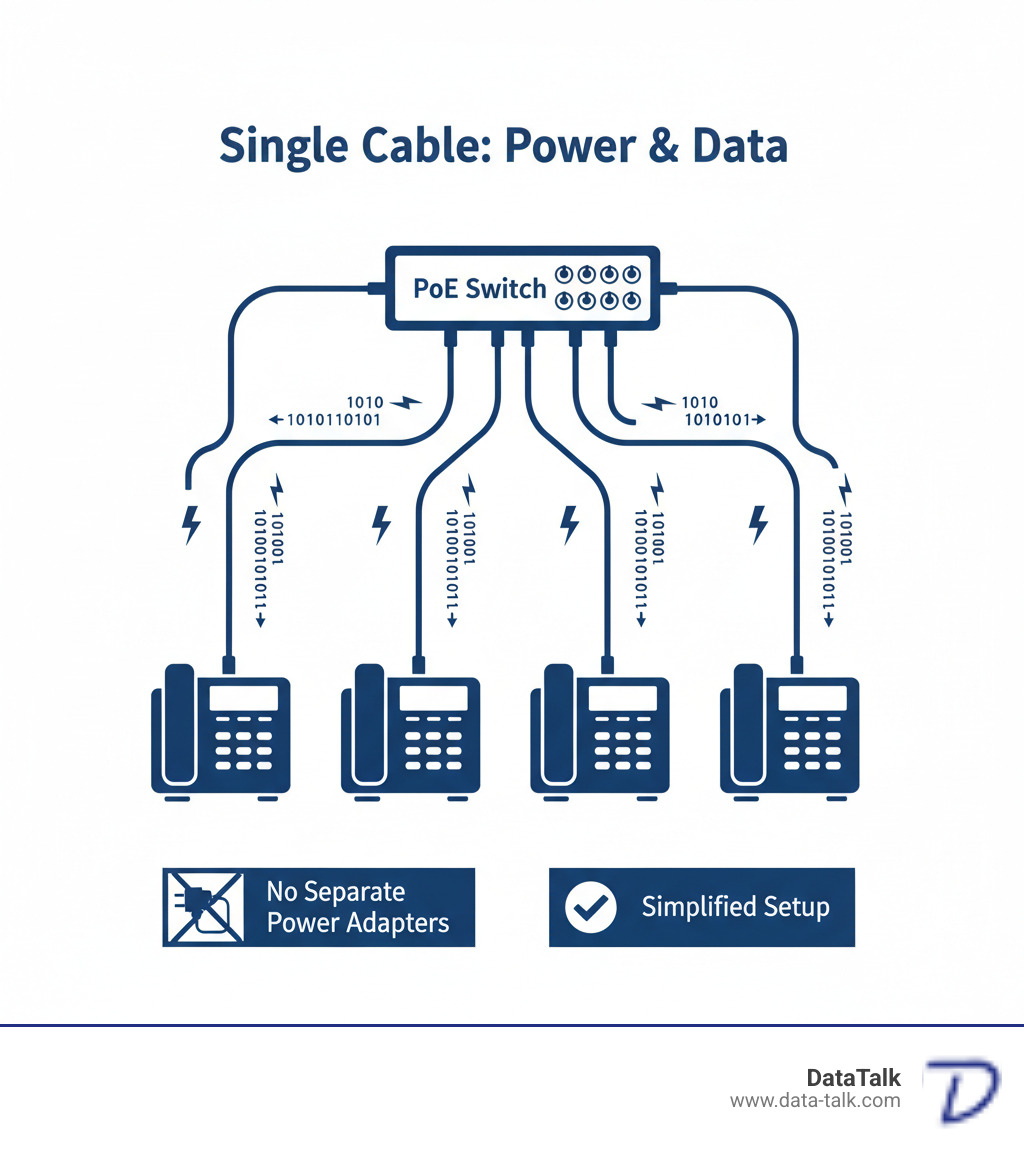
A PoE phone system uses Power over Ethernet technology to deliver both electrical power and network connectivity to VoIP phones through a single Ethernet cable, eliminating the need for separate power adapters and outlets.

Key advantages of PoE phone systems:

  • Single cable solution – One Ethernet cable provides both power and data connection
  • Simplified installation – No electrician needed to install power outlets near each phone
  • Reduced clutter – Eliminates bulky power adapters and excess cabling
  • Centralized power – Connect phones to a UPS for backup power during outages
  • Easy scalability – Add or move phones anywhere with Ethernet access
  • Cost savings – Lower installation costs and reduced energy consumption

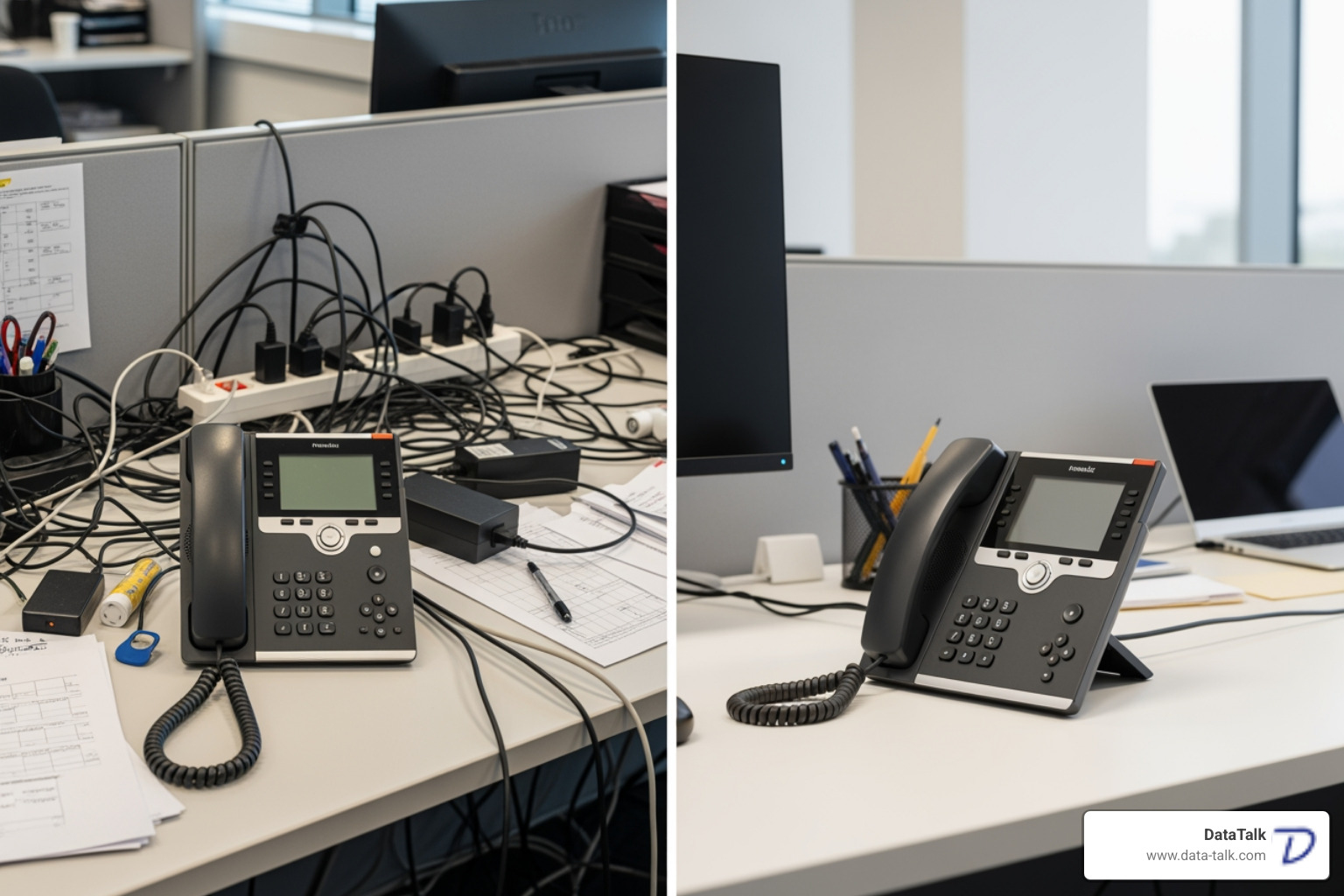
Tired of tangled cables cluttering your desk? Traditional phone systems create a messy workspace with separate power and network cords. PoE phone systems solve this by combining power and data into a single Ethernet cable. You plug in one cord that handles everything, eliminating trip hazards and disorganization.

For Ohio businesses upgrading from outdated phone systems, PoE is the modern standard. It simplifies deployment, reduces costs, and makes network management easier. Understanding how PoE works is key to making smart decisions for your new or existing office’s communication infrastructure.

Infographic showing a PoE network switch with multiple Ethernet ports connected to VoIP desk phones, with arrows indicating both electrical power (depicted as lightning bolts) and network data (depicted as binary digits) flowing simultaneously through a single Ethernet cable to each phone, eliminating the need for separate power adapters - poe phone system infographic

What is a PoE Phone System and How Does It Work?

A PoE phone system eliminates the need for wall outlets and bulky power adapters by delivering everything your phone needs through a single cable. Power over Ethernet (PoE) is a networking standard that allows an Ethernet cable to carry both data for your VoIP Phone Systems and the electrical power to operate them.

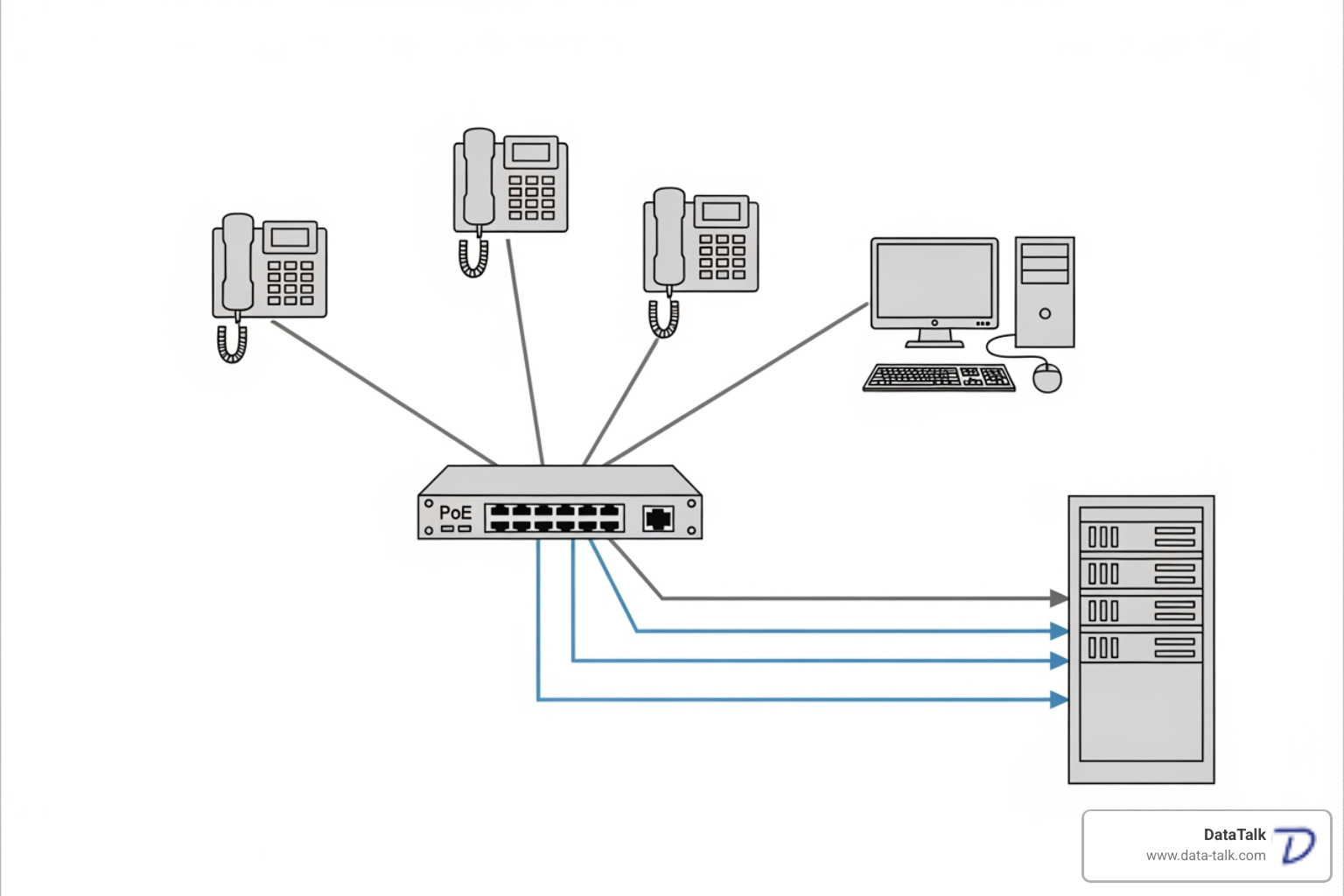
Here’s how it works: A PoE switch in your server room or telecom closet converts AC power to low-voltage DC power. It sends this power, along with network data, through standard Ethernet cables (Cat5e or Cat6). Your PoE-compatible VoIP phone then receives the cable, splits the signals, and uses the data for calls and the power to stay on. It’s a seamless, single-cable connection.

While often used interchangeably, IP telephony and VoIP (Voice over IP) have a subtle difference. VoIP specifically refers to converting your voice into data packets for internet transmission. IP telephony is a broader term that includes VoIP calls, video conferencing, and other IP-based communication tools.

A PoE phone system describes how these modern tools get power and data. Phones can be placed anywhere an Ethernet port is available, not just near power outlets. The PoE switch centrally manages power and data delivery, changing a complex installation into a simple, plug-and-play setup.

network diagram showing a PoE switch connecting to multiple VoIP phones, a computer, and a server - poe phone system

The Core Benefits of Switching to a PoE Phone System

Switching to a PoE phone system offers remarkable benefits for your office, from installation to daily operations. Let’s explore the core advantages.

Simplified Installation and Reduced Clutter

With a traditional phone system, setting up new workstations means hunting for power outlets and potentially hiring an electrician. A PoE phone system simplifies this: just run one Ethernet cable to the desk and plug in the phone. This single-cable approach eliminates the tangled mess of power bricks and cords, creating a cleaner, more professional workspace and reducing trip hazards. You gain the flexibility to place phones anywhere an Ethernet cable can reach, even far from an outlet, making office rearrangements simple. As we noted in The Business Communications Revolution: Understanding How VoIP Phone Systems Work, Their Benefits, PoE excels at removing complexity.

cluttered desk with a traditional phone's power brick and cables versus a clean desk with a single-cable PoE phone - poe phone system

Improved Reliability and Centralized Power

What happens to your phones during a power outage? With traditional systems, each phone dies. A PoE phone system solves this by drawing power from a central PoE switch. By connecting that switch to an Uninterruptible Power Supply (UPS), your entire phone system stays online during an outage, ensuring business continuity. This allows your Columbus team to keep working when others can’t. Centralized power also enables remote management, letting you restart a malfunctioning phone from your network closet instead of at the desk, giving you greater control and peace of mind.

Cost-Effectiveness and Energy Efficiency

A PoE phone system is typically cheaper to install than traditional systems because you avoid the cost of hiring electricians to add new power outlets. These upfront savings are significant for budget-conscious small businesses, a point we’ve seen with companies in Hilliard, as noted in 5 Ways a Cloud-Based Phone System Can Reduce Costs for Hilliard, Ohio Small Businesses. The savings continue long-term, as modern PoE switches use energy-saving features to deliver only the necessary power to each device, lowering your monthly energy bills. Furthermore, eliminating individual power adapters reduces electronic waste, making PoE an environmentally friendly choice.

Greater Flexibility and Scalability

Your business needs a phone system that can adapt and grow. With a PoE phone system, phones aren’t tied to electrical outlets, so you can place them anywhere your Ethernet network reaches. Adding a new employee or moving a desk is as simple as plugging a phone into a different network port—no electricians or complex planning required. This scalability allows your Ohio business to expand without major infrastructure changes. As highlighted in Why Small Businesses Need VoIP Phone Systems, this agility is essential for modern businesses.

Essential Equipment and PoE Standards for Your Setup

Setting up a PoE phone system is straightforward once you understand the essential hardware and standards. Let’s break down what you need.

Key Hardware for Your PoE Phone System

Choosing the right equipment is the foundation of your PoE phone system, and you only need a few key components.

  • PoE Switches: The core of most business deployments, these act as a combined power station and network hub. A multi-port PoE switch can power an entire team’s phones, keeping your network organized.
  • PoE Injectors: For smaller setups, like a home office in Columbus or adding just one or two phones, injectors are a flexible alternative. They add power to an existing data line from a non-PoE switch.
  • PoE-compatible VoIP phones: Most modern business phones from brands like Yealink, Grandstream, and Zultys are PoE-ready. Always check device specifications for 802.3af or 802.3at support.
  • Ethernet Cabling: Category 5e or Cat6 cables are needed to connect everything, carrying both data and power. Cat6 is recommended for better performance and future-proofing.

Your PoE infrastructure is also versatile. Beyond phones, it can power devices like IP cameras, Wireless Access Points, and video conferencing systems, maximizing your investment.

Understanding PoE Standards

Understanding PoE standards is technical but crucial for choosing the right equipment and avoiding compatibility issues. The IEEE (Institute of Electrical and Electronics Engineers) defines how much power can be sent over Ethernet. For a deeper dive, A guide to PoE standards and wattage offers comprehensive details.

These standards help you calculate your power budget—the total power your PoE switch must supply. For example, ten 12-watt phones require a switch with at least a 120-watt total power budget. Always choose Active PoE for business phone systems, as it safely negotiates power needs with each device.

PoE Standard Max Power per Port (PSE) Power to Device (PD) Typical Use Cases
802.3af (PoE) 15.4 W 12.95 W Standard VoIP phones, static IP cameras, WAPs
802.3at (PoE+) 30 W 25.5 W Video phones, PTZ cameras, high-performance WAPs
802.3bt (PoE++) Type 3 60 W 51 W Laptops, LED lighting, video conferencing systems
802.3bt (PoE++) Type 4 100 W 71 W Large displays, high-power industrial sensors

For most Ohio businesses setting up a standard PoE phone system, 802.3af or 802.3at is sufficient. Matching the standard to your needs ensures a reliable system from day one.

Best Practices for Deployment and Security

Proper deployment and security are crucial for getting the most from your PoE phone system. A thoughtful strategy ensures a secure, high-performing investment.

Choosing and Configuring Your PoE Phone System

Before connecting phones, calculate your power budget to ensure your PoE switch can handle all connected devices. A stable network is also critical for clear voice quality. That’s why we offer our VOIP Scout Test to Ohio businesses, an assessment that confirms your network is ready for VoIP traffic before deployment.

During configuration, prioritize two key settings:

  • Quality of Service (QoS): Configure QoS to prioritize voice packets over other data, preventing choppy calls. As detailed in our guide on Everything Columbus, Ohio Entrepreneurs Should Know About VoIP QoS, this is key to great call quality.
  • VLANs (Virtual Local Area Networks): Use VLANs to create a separate network lane for your voice traffic. This network segmentation improves both performance and security.

Security Considerations for PoE Networks

Your PoE phone system is part of your network and requires strong security. For a comprehensive guide, read Is Your VoIP Phone System Secure?. Key practices include:

  • Physical Security: Keep PoE switches in locked rooms or cabinets.
  • VLAN Segmentation: Isolate your voice network from your data network.
  • Disable Unused Ports: Turn off open ports on switches to block unauthorized connections.
  • Regular Firmware Updates: Keep switch and phone firmware updated to patch vulnerabilities.
  • Strong Access Control: Use complex passwords and multi-factor authentication for switch management.
  • Network Monitoring: Watch for unusual activity that could signal a security issue.

PoE technology continues to evolve, making PoE phone systems a smart investment. Key trends include:

  • Higher Power Standards: Future standards will support more demanding devices like large displays and smart lighting.
  • Smart Power Management: Intelligent systems will dynamically allocate power to increase efficiency.
  • Integration with IoT: PoE is becoming the standard for powering and connecting IoT devices.
  • Single-Pair Ethernet (SPE): This emerging technology uses lighter, thinner cables, simplifying installations for certain devices.

These advancements ensure that PoE will become even more versatile and integral to business operations.

Frequently Asked Questions about PoE Phone Systems

We hear these questions from business owners across Ohio. Here are answers to the most common ones to help you make an informed decision about your PoE phone system.

Are all VoIP phones PoE compatible?

No, but most modern business-grade VoIP phones are. They typically come with a PoE-enabled Ethernet port and a backup port for a traditional AC adapter. Older or consumer-grade models may require a separate power supply. Always check the device specifications for IEEE 802.3af or 802.3at support before purchasing.

Can PoE be used with Wi-Fi VoIP phones?

No. PoE requires a physical Ethernet cable to transmit power. Wi-Fi provides a wireless data connection but cannot transmit electricity. Therefore, Wi-Fi VoIP phones still require a separate AC power adapter plugged into a wall outlet to function.

What’s the difference in using PoE for a home office vs. a large enterprise?

PoE technology scales from a single home office to a large enterprise, with the main differences being equipment and complexity.

  • Home Office: For one or two phones in a location like Clintonville, a single PoE injector is a simple, budget-friendly solution. It adds power to your existing network line without needing a new switch.
  • Large Enterprise: For offices in Columbus or Cincinnati with dozens or hundreds of phones, PoE switches are essential. They offer centralized power management, simplified maintenance, and support for a single UPS backup. Enterprise switches also provide advanced features like VLANs and QoS, which are crucial for managing a large, high-quality phone system.

Conclusion: Is a PoE Phone System Right for Your Business?

A PoE phone system is a game-changer for modern businesses. The advantages are clear: simplified installation, improved reliability via centralized power, cost-effectiveness, and greater scalability. For any business in Ohio, from a Clintonville startup to a Columbus enterprise, these benefits directly impact daily operations and the bottom line. PoE technology eliminates cable clutter and complex installations, creating a clean, professional setup that’s easy to maintain and expand. Adding new team members is as simple as plugging in a phone—no electrician required.

At DataTalk, we’ve helped countless Ohio businesses transition to modern communication systems. We understand every business is unique, which is why we start with our “VOIP Scout Test” to assess your network readiness. This guarantees your infrastructure can deliver crystal-clear voice quality before any phones are deployed. Serving Columbus, Akron, Cincinnati, and all of Ohio, our team provides telecom solutions and data cabling custom to the local business landscape, ensuring your upgrade is smooth and successful.

Is a PoE phone system right for your business? If you value simplicity, reliability, and a scalable infrastructure, the answer is a clear yes. We’re here to make it happen.

Ready to modernize your business communications? Learn more about our Business Phone Systems and find how we can transform the way your team connects.

Ring, Ring, Realty: How VoIP Elevates Communication for Property Pros and Call Centers

Why Communication is Make-or-Break in Real Estate


VoIP for real estate transforms how agents, brokers, and property managers communicate by delivering internet-based phone systems that enable mobility, reduce costs, and provide advanced features like call forwarding, CRM integration, and auto-attendants—all without the limitations of traditional desk phones.

Key benefits of VoIP for real estate professionals:

  • Mobility – Take calls anywhere using your business number on smartphones or laptops
  • Cost Savings – Cut phone costs by up to 50% compared to traditional systems
  • Professional Features – Auto-attendants, call routing, and voicemail-to-email
  • CRM Integration – Automatically log calls and access client data during conversations
  • Local Presence – Use local numbers in multiple markets to build trust
  • Never Miss Leads – Call forwarding ensures you’re reachable during property showings

The real estate industry runs on relationships, which depend on communication. Yet, for many Ohio real estate professionals, staying connected is a challenge. Traditional desk phones chain you to one location, while cell phones mix business with personal. Old PBX systems are expensive, inflexible, and lack modern features.

Research shows that up to 60% of customers prefer calling businesses. In real estate, a single missed call can mean a lost commission. VoIP (Voice over Internet Protocol) solves these problems by using your internet connection instead of phone lines. It gives you freedom, professionalism, and powerful tools at a fraction of the cost, adapting to your needs without expensive hardware or IT expertise.

Infographic showing how VoIP converts voice into digital data packets that travel over the internet to the recipient, where they're converted back into voice, with icons representing a phone, data packets, internet cloud, and receiving phone - voip for real estate infographic infographic-line-3-steps-blues-accent_colors

From Dial-Up to Digital: What is VoIP and Why is it a Game-Changer for Real Estate?

Just as the internet evolved, so has business communication. Voice over Internet Protocolor VoIPrepresents a major leap forward for phone systems. VoIP for real estate turns your voice into digital data and sends it over your internet connection instead of traditional phone lines. No more being chained to a desk or paying high fees for long-distance calls.

For real estate professionals across Ohio, this fundamentally changes how you do business. Old PBX systems required expensive hardware and technician visits for simple changes. VoIP changes everything. Need to add new agents? Do it in minutes. Downsizing? Scale back just as easily. You only pay for what you use, with many agencies cutting phone bills by 50% or more.

But the real magic is looking and sounding more professional. VoIP provides enterprise-level features like custom greetings, professional music on hold, and auto-attendants that route calls intelligently. The business communications revolution is here, and for real estate pros, VoIP is essential.

Never Miss a Lead: Mobility and Remote Work

Real estate agents don’t work in offices. Your office is wherever your clients need you to be. So why use a phone system that requires you to be at a desk?

This is where VoIP for real estate becomes transformative. Imagine a serious buyer calls your office number during an open house. With a traditional system, that call goes to voicemail. With VoIP, it rings on your smartphoneusing your business number. You answer professionally, and the buyer just knows you were available.

This works through softphone apps that turn any smartphone, tablet, or laptop into your business phone. As long as you have internet, you have your full phone system. Features like “Find Me/Follow Me” routing try your desk phone, then your mobile, then a colleague before going to voicemail, ensuring every effort is made to reach a real person.

This flexibility is a competitive advantage. In a business where responding minutes faster can win a listing, mobility matters. Best of all, you never have to give out your personal cell number, allowing you to maintain a work-life balance. For more insights, check out these benefits for remote working.

Improve Professionalism and Client Experience

Your first impression often happens over the phone. VoIP for real estate systems ensure it’s a polished and professional one.

  • Auto-Attendant (IVR): Instead of endless ringing, callers hear a professional greeting: “Thank you for calling Smith Realty. Press 1 for sales, press 2 for properties.” This routes callers efficiently to the right person.
  • Custom Greetings & Music on Hold: Record different messages for business hours versus evenings. Professional hold music keeps callers engaged and reassures them they haven’t been disconnected.
  • Virtual Phone Numbers: Expanding from Columbus to the Cincinnati market? Get a local Cincinnati number in minutes, no physical office required. Local numbers build trust with potential clients.
  • Voicemail-to-Email: Get an email with a text transcript of every voicemail. Scan messages in seconds, prioritize hot leads, and respond faster than the competition.

Each feature sends a clear message: you’re professional, organized, and easy to work with. Explore the full range of capabilities in this VoIP system features overview.

Streamline Operations with Powerful Integrations

Real estate runs on information. Juggling phone logs, client notes, and property data is inefficient and prone to error. VoIP for real estate can become the central hub of your operation through powerful integrations.

The magic is CRM integration. When your VoIP system connects to your CRM, everything syncs. A client calls, and their information, call history, and notes pop up on your screen. You’re instantly prepared, and every call is automatically logged. No more manual data entry.

Call recording is invaluable for training, quality assurance, and record-keeping. Paired with AI transcription, you can even search conversations for keywords. VoIP analytics reveal call volume patterns, agent performance, and missed call rates, helping you make smarter staffing and strategy decisions. This unified approach keeps your entire team on the same page. Modern VoIP systems are built to play nicely with the tools you already use, but if you face issues, here’s guidance on fixing integration issues.

The Bottom Line: Cost and ROI of VoIP for Real Estate Agencies

Let’s talk money. For real estate agencies across Ohio, VoIP for real estate delivers a financial advantage that’s hard to ignore.

Traditional PBX systems are a financial drain. They require a massive upfront investment in hardware, plus ongoing maintenance fees, service contracts, and per-line charges. When something breaks, you face costly repairs or replacements.

VoIP flips this model. Instead of buying equipment, you use a cloud-based system with a straightforward per-user billing structure. You only pay for what you use, making budgets predictable. The hardware investment disappears, and your provider handles all infrastructure and maintenance. Because it’s cloud-based, you get built-in disaster recovery; if your Columbus office loses power, calls automatically route to mobile devices.

The real return on investment goes beyond cutting your monthly bill, though agencies often see savings of 50-60%. Think of the efficiency gains: more leads captured, less time on paperwork, and data to track which marketing campaigns are driving calls. For a ten-agent agency, this means thousands saved annually plus the revenue from leads that are no longer missed. Learn more about how cloud phones reduce costs for Hilliard, Ohio small businesses. The financial case for VoIP for real estate is a no-brainer.

Choosing and Implementing the Right VoIP for Real Estate

Picking the right VoIP for real estate system is like matching a buyer to the right home—it needs to fit your specific needs.

Start by assessing your agency’s needs. Consider your call volume: are you a high-traffic brokerage in downtown Columbus or a boutique firm in Clintonville? How many users—agents, staff, and managers—need access? This number directly impacts your monthly cost under per-user billing.

While VoIP saves money, understand the full budget. Ask about setup fees, monthly charges, and costs for add-ons. Always request a demo or trial. Finally, plan for scalability. Your phone system should flex with your business, allowing you to add or remove users easily. Don’t forget to check vendor reputation and customer support. When your phones are your lifeline, you need a partner who responds quickly. Real-world insights from other Ohio agents are invaluable.

A Buyer’s Checklist for Your Real Estate VoIP System

When you’re ready to seriously evaluate VoIP for real estate options, keep these essential considerations front and center. Think of them as the “must-haves” versus the “nice-to-haves” in your property listings—except these are all must-haves.

Mobility features sit at the top of the list. Your agents spend most of their time away from a desk, so robust softphone apps for smartphones and laptops aren’t optional. Look for reliable call forwarding and “Find Me/Follow Me” routing that actually works when you’re showing a property or driving between appointments.

CRM compatibility is your second non-negotiable. If your VoIP system doesn’t talk nicely with your existing customer relationship management software, you’re creating more work, not less. Seamless integration means automatic call logging, instant access to client histories, and one unified place to manage all your relationships.

Strong call management tools separate professional agencies from amateur operations. You’ll want a solid Auto-Attendant (IVR) to route calls intelligently, call recording for training and quality assurance, call queues for busy periods, and voicemail-to-email transcription so you never miss important details.

Security protocols matter more than ever. You’re handling sensitive financial information, personal details, and confidential negotiations. Ask potential providers specific questions about encryption, data protection standards, and how they safeguard your communications. Vague answers should raise red flags.

Scalability options ensure you’re not locked into today’s configuration when tomorrow’s needs change. Can you add users easily? Remove them without penalties? Adjust features as your agency evolves? Flexibility here saves headaches and money down the road.

Finally, demand pricing transparency. Hidden fees are the termites of phone systems—they eat away at your budget quietly. Get everything in writing: monthly per-user costs, international calling rates if you work with overseas investors, charges for additional features, and any setup or training fees. If a provider can’t give you straight answers, keep looking.

Overcoming Potential Challenges with your voip for real estate

VoIP for real estate is transformative, but it’s wise to understand potential challenges, all of which are manageable with preparation.

  • Internet Dependency: Your phones run on your internet. A spotty connection means spotty calls. A reliable, high-quality internet service is non-negotiable.
  • Power Outages: VoIP phones need power. A backup power source for your router and switches is a good idea, though calls can always be routed to mobile devices that have their own power and data.
  • Call Quality Concerns: Choppy audio or delays almost always trace back to network issues, not the VoIP system. A properly configured network prevents this.
  • Data Security: You’re transmitting sensitive client data. Ensure your provider uses strong encryption and complies with privacy regulations. Learn more about how your business can protect your VoIP phone system.
  • User Adoption: New technology requires some training. Plan for a smooth transition to ensure your team can leverage all the new features.

The Importance of Network Readiness for voip for real estate

Many agencies stumble by overlooking network readiness. Having “fast internet” isn’t enough; the quality of that connection is what matters for voice.

Quality of Service (QoS) is crucial. It prioritizes voice data over other internet traffic, like video streaming or large downloads. Without QoS, your important client call competes for bandwidth, resulting in choppy audio. You also need enough bandwidth for all simultaneous calls plus your normal data usage.

Technical issues like jitter (robotic-sounding voices) and latency (awkward conversational delays) are also caused by network problems. This is why we created our VOIP Scout Test at DataTalk. Before deploying any VoIP for real estate system in Ohio, we thoroughly test your network to identify and fix potential issues. We check bandwidth, jitter, latency, and QoS configuration to guarantee optimal voice quality from day one.

Think of it as a home inspection for your phone system—an essential step for peace of mind and professional communication. For more details, explore everything Columbus, Ohio entrepreneurs should know about VoIP QoS.

Frequently Asked Questions about VoIP in Real Estate

We talk to real estate professionals every day who are curious about making the switch to VoIP. So let’s tackle the big ones head-on.

Is VoIP reliable enough for a busy real estate agency?

Yes, absolutely. Modern VoIP for real estate systems are built for businesses that live by the phone. Reliability is paramount when a missed call can be a missed commission.

Unlike older systems, VoIP thrives in demanding environments with features like call queues and intelligent routing to ensure every lead is handled. The biggest advantage is business continuity. If power goes out at your Columbus office, calls automatically route to mobile devices. Your clients never know there’s an issue. The key is a reputable provider and a solid network—which is why we perform our VOIP Scout Test to guarantee call clarity before you go live.

Can I keep my existing business phone number when switching to VoIP?

Yes. You absolutely can, and should, keep your existing business phone number. It’s a core part of your brand, appearing on signs, cards, and marketing across Ohio.

The process is called “number porting,” and it’s a standard, seamless procedure. We handle the entire transfer for you, moving your number to the new VoIP for real estate system with little to no downtime. Your clients continue to call the same number they always have.

How does VoIP help with marketing my properties and tracking leads?

VoIP for real estate is a powerful marketing and lead tracking tool.

First, you gain a local presence advantage. Easily add virtual local numbers for any market you serve, like Akron or Cincinnati, even if your office is in Columbus. This builds trust with local buyers.

Second, you improve lead capture and tracking. CRM integration automatically logs every call, linking it to a client’s record. This allows you to see which marketing campaigns (like a Zillow listing or Facebook ad) are actually driving phone calls. You can track lead sources and measure ROI with real data, not guesswork.

Finally, call analytics provide deeper insights into call volumes and peak times, helping you optimize staffing and strategy. Every feature works to help you capture more leads, track them effectively, and close more deals.

Conclusion: Future-Proof Your Agency’s Communication

The real estate business moves fast, and your phone system is its lifeline. VoIP for real estate is the modern solution that frees you from the desk, saves money, and ensures you sound professional from anywhere. Most importantly, it helps you capture every call that could be your next big commission.

Across Ohio, from Columbus to Cincinnati, top agents are using VoIP to pull ahead of the competition. Features like mobility, CRM integration, and professional auto-attendants are no longer luxuries; they are the foundation of a successful modern agency. Your competitors are using them, and your clients expect that level of service.

At DataTalk, we make the switch simple. Our unique “VOIP Scout Test” is our promise to you: we test your network before deployment to guarantee every call is crystal clear. No surprises, just reliable, professional communication.

Your agency deserves a phone system that works as hard as you do. Ready to transform how your team communicates? Explore professional VoIP phone services in Columbus, Ohio and let’s future-proof your agency together.