
Simplifying Your Office Communications
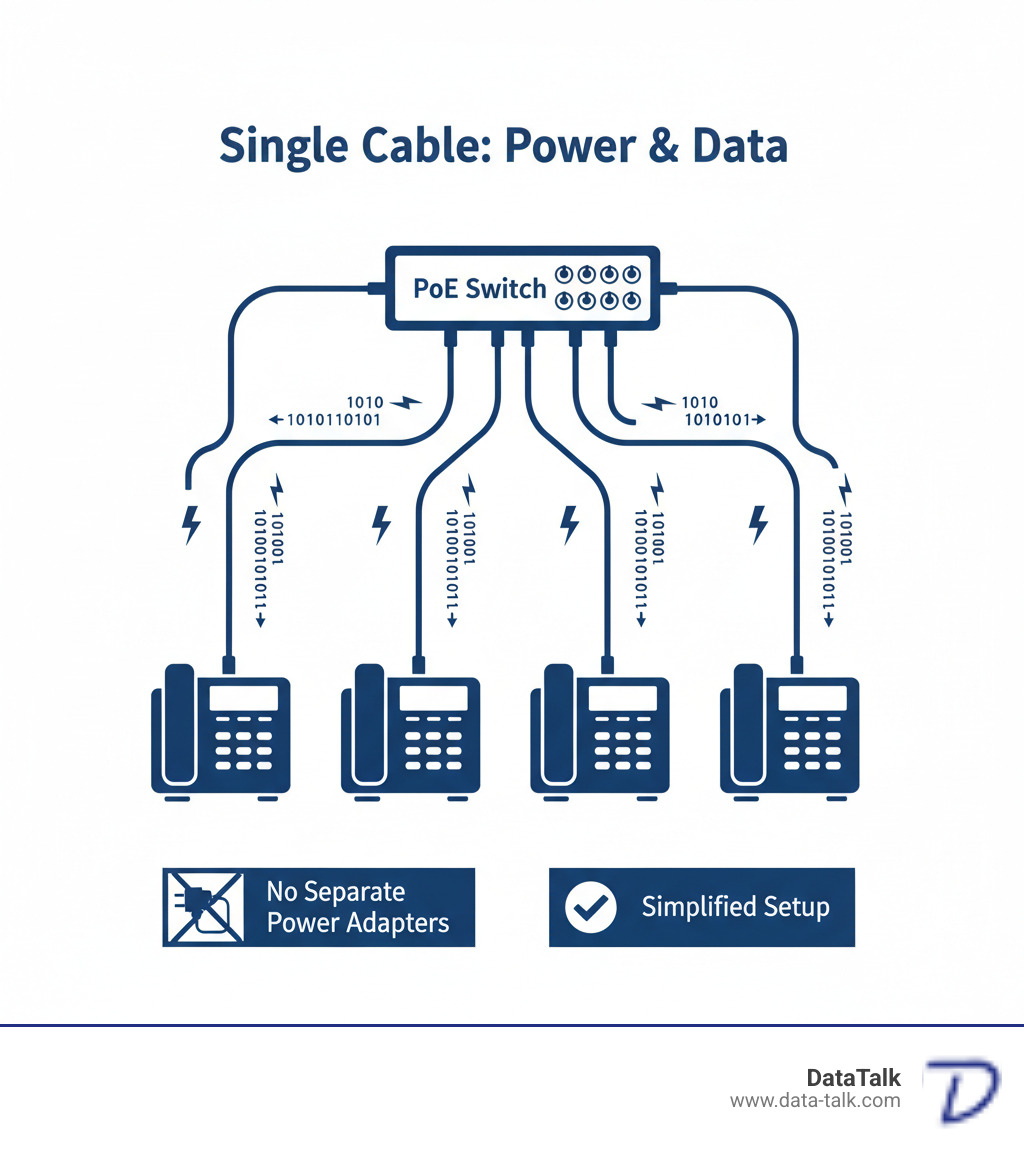
A PoE phone system uses Power over Ethernet technology to deliver both electrical power and network connectivity to VoIP phones through a single Ethernet cable, eliminating the need for separate power adapters and outlets.
Key advantages of PoE phone systems:
- Single cable solution – One Ethernet cable provides both power and data connection
- Simplified installation – No electrician needed to install power outlets near each phone
- Reduced clutter – Eliminates bulky power adapters and excess cabling
- Centralized power – Connect phones to a UPS for backup power during outages
- Easy scalability – Add or move phones anywhere with Ethernet access
- Cost savings – Lower installation costs and reduced energy consumption
Tired of tangled cables cluttering your desk? Traditional phone systems create a messy workspace with separate power and network cords. PoE phone systems solve this by combining power and data into a single Ethernet cable. You plug in one cord that handles everything, eliminating trip hazards and disorganization.
For Ohio businesses upgrading from outdated phone systems, PoE is the modern standard. It simplifies deployment, reduces costs, and makes network management easier. Understanding how PoE works is key to making smart decisions for your new or existing office’s communication infrastructure.
What is a PoE Phone System and How Does It Work?
A PoE phone system eliminates the need for wall outlets and bulky power adapters by delivering everything your phone needs through a single cable. Power over Ethernet (PoE) is a networking standard that allows an Ethernet cable to carry both data for your VoIP Phone Systems and the electrical power to operate them.
Here’s how it works: A PoE switch in your server room or telecom closet converts AC power to low-voltage DC power. It sends this power, along with network data, through standard Ethernet cables (Cat5e or Cat6). Your PoE-compatible VoIP phone then receives the cable, splits the signals, and uses the data for calls and the power to stay on. It’s a seamless, single-cable connection.
While often used interchangeably, IP telephony and VoIP (Voice over IP) have a subtle difference. VoIP specifically refers to converting your voice into data packets for internet transmission. IP telephony is a broader term that includes VoIP calls, video conferencing, and other IP-based communication tools.
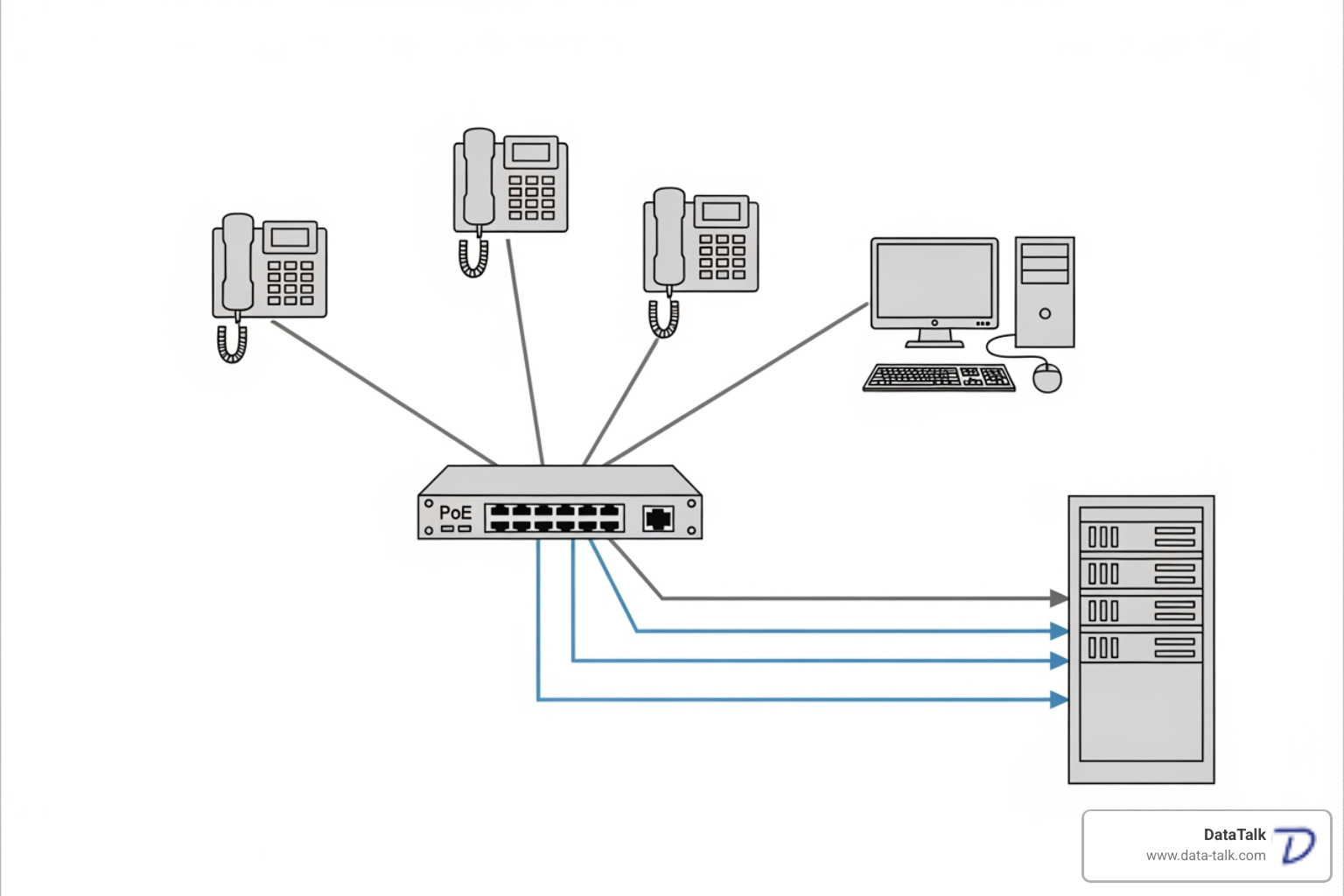
A PoE phone system describes how these modern tools get power and data. Phones can be placed anywhere an Ethernet port is available, not just near power outlets. The PoE switch centrally manages power and data delivery, changing a complex installation into a simple, plug-and-play setup.
The Core Benefits of Switching to a PoE Phone System
Switching to a PoE phone system offers remarkable benefits for your office, from installation to daily operations. Let’s explore the core advantages.
Simplified Installation and Reduced Clutter
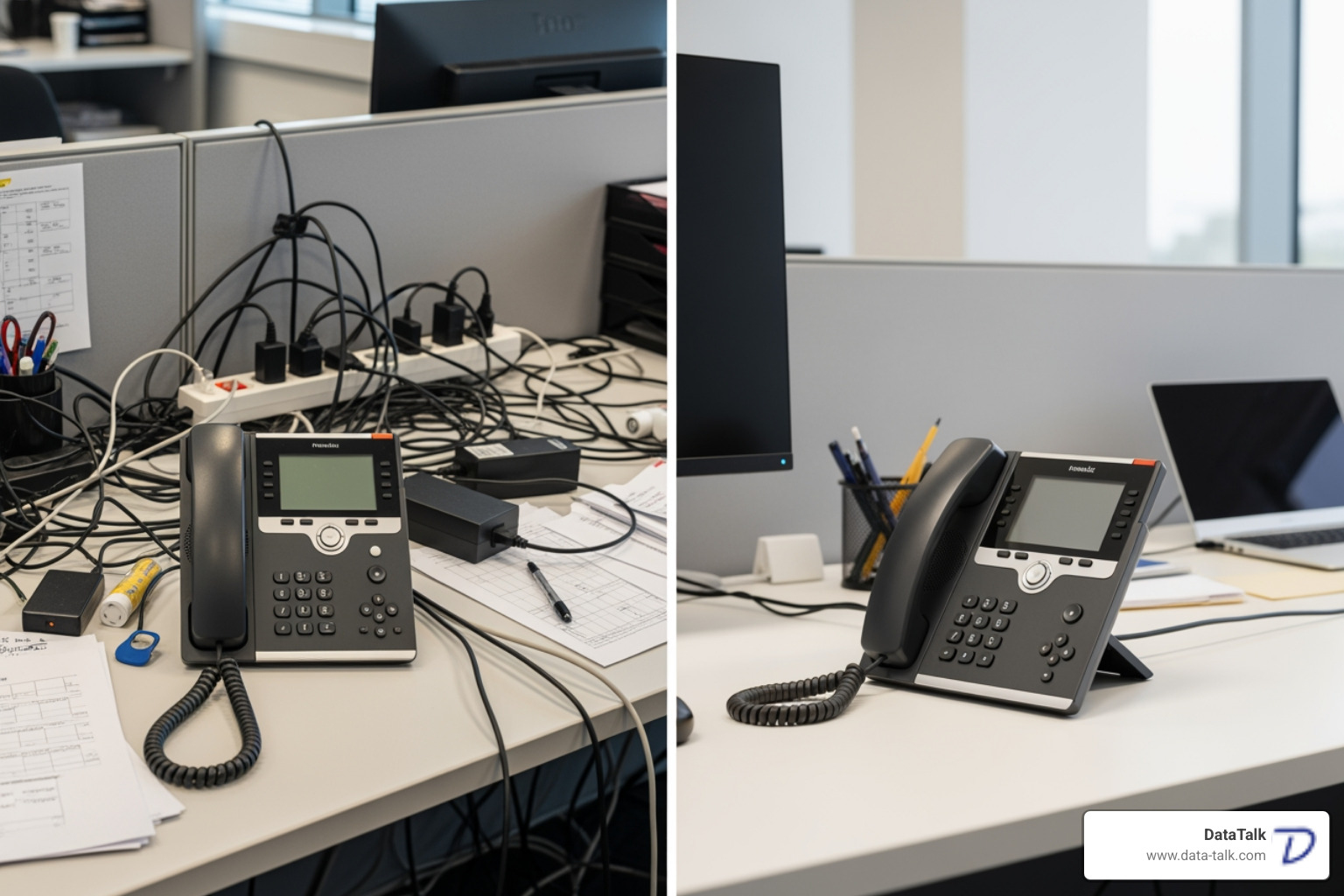
With a traditional phone system, setting up new workstations means hunting for power outlets and potentially hiring an electrician. A PoE phone system simplifies this: just run one Ethernet cable to the desk and plug in the phone. This single-cable approach eliminates the tangled mess of power bricks and cords, creating a cleaner, more professional workspace and reducing trip hazards. You gain the flexibility to place phones anywhere an Ethernet cable can reach, even far from an outlet, making office rearrangements simple. As we noted in The Business Communications Revolution: Understanding How VoIP Phone Systems Work, Their Benefits, PoE excels at removing complexity.
Improved Reliability and Centralized Power
What happens to your phones during a power outage? With traditional systems, each phone dies. A PoE phone system solves this by drawing power from a central PoE switch. By connecting that switch to an Uninterruptible Power Supply (UPS), your entire phone system stays online during an outage, ensuring business continuity. This allows your Columbus team to keep working when others can’t. Centralized power also enables remote management, letting you restart a malfunctioning phone from your network closet instead of at the desk, giving you greater control and peace of mind.
Cost-Effectiveness and Energy Efficiency
A PoE phone system is typically cheaper to install than traditional systems because you avoid the cost of hiring electricians to add new power outlets. These upfront savings are significant for budget-conscious small businesses, a point we’ve seen with companies in Hilliard, as noted in 5 Ways a Cloud-Based Phone System Can Reduce Costs for Hilliard, Ohio Small Businesses. The savings continue long-term, as modern PoE switches use energy-saving features to deliver only the necessary power to each device, lowering your monthly energy bills. Furthermore, eliminating individual power adapters reduces electronic waste, making PoE an environmentally friendly choice.
Greater Flexibility and Scalability
Your business needs a phone system that can adapt and grow. With a PoE phone system, phones aren’t tied to electrical outlets, so you can place them anywhere your Ethernet network reaches. Adding a new employee or moving a desk is as simple as plugging a phone into a different network port—no electricians or complex planning required. This scalability allows your Ohio business to expand without major infrastructure changes. As highlighted in Why Small Businesses Need VoIP Phone Systems, this agility is essential for modern businesses.
Essential Equipment and PoE Standards for Your Setup
Setting up a PoE phone system is straightforward once you understand the essential hardware and standards. Let’s break down what you need.
Key Hardware for Your PoE Phone System
Choosing the right equipment is the foundation of your PoE phone system, and you only need a few key components.
- PoE Switches: The core of most business deployments, these act as a combined power station and network hub. A multi-port PoE switch can power an entire team’s phones, keeping your network organized.
- PoE Injectors: For smaller setups, like a home office in Columbus or adding just one or two phones, injectors are a flexible alternative. They add power to an existing data line from a non-PoE switch.
- PoE-compatible VoIP phones: Most modern business phones from brands like Yealink, Grandstream, and Zultys are PoE-ready. Always check device specifications for 802.3af or 802.3at support.
- Ethernet Cabling: Category 5e or Cat6 cables are needed to connect everything, carrying both data and power. Cat6 is recommended for better performance and future-proofing.
Your PoE infrastructure is also versatile. Beyond phones, it can power devices like IP cameras, Wireless Access Points, and video conferencing systems, maximizing your investment.
Understanding PoE Standards
Understanding PoE standards is technical but crucial for choosing the right equipment and avoiding compatibility issues. The IEEE (Institute of Electrical and Electronics Engineers) defines how much power can be sent over Ethernet. For a deeper dive, A guide to PoE standards and wattage offers comprehensive details.
These standards help you calculate your power budget—the total power your PoE switch must supply. For example, ten 12-watt phones require a switch with at least a 120-watt total power budget. Always choose Active PoE for business phone systems, as it safely negotiates power needs with each device.
| PoE Standard | Max Power per Port (PSE) | Power to Device (PD) | Typical Use Cases |
|---|---|---|---|
| 802.3af (PoE) | 15.4 W | 12.95 W | Standard VoIP phones, static IP cameras, WAPs |
| 802.3at (PoE+) | 30 W | 25.5 W | Video phones, PTZ cameras, high-performance WAPs |
| 802.3bt (PoE++) Type 3 | 60 W | 51 W | Laptops, LED lighting, video conferencing systems |
| 802.3bt (PoE++) Type 4 | 100 W | 71 W | Large displays, high-power industrial sensors |
For most Ohio businesses setting up a standard PoE phone system, 802.3af or 802.3at is sufficient. Matching the standard to your needs ensures a reliable system from day one.
Best Practices for Deployment and Security
Proper deployment and security are crucial for getting the most from your PoE phone system. A thoughtful strategy ensures a secure, high-performing investment.
Choosing and Configuring Your PoE Phone System
Before connecting phones, calculate your power budget to ensure your PoE switch can handle all connected devices. A stable network is also critical for clear voice quality. That’s why we offer our VOIP Scout Test to Ohio businesses, an assessment that confirms your network is ready for VoIP traffic before deployment.
During configuration, prioritize two key settings:
- Quality of Service (QoS): Configure QoS to prioritize voice packets over other data, preventing choppy calls. As detailed in our guide on Everything Columbus, Ohio Entrepreneurs Should Know About VoIP QoS, this is key to great call quality.
- VLANs (Virtual Local Area Networks): Use VLANs to create a separate network lane for your voice traffic. This network segmentation improves both performance and security.
Security Considerations for PoE Networks
Your PoE phone system is part of your network and requires strong security. For a comprehensive guide, read Is Your VoIP Phone System Secure?. Key practices include:
- Physical Security: Keep PoE switches in locked rooms or cabinets.
- VLAN Segmentation: Isolate your voice network from your data network.
- Disable Unused Ports: Turn off open ports on switches to block unauthorized connections.
- Regular Firmware Updates: Keep switch and phone firmware updated to patch vulnerabilities.
- Strong Access Control: Use complex passwords and multi-factor authentication for switch management.
- Network Monitoring: Watch for unusual activity that could signal a security issue.
Future Trends in PoE Technology
PoE technology continues to evolve, making PoE phone systems a smart investment. Key trends include:
- Higher Power Standards: Future standards will support more demanding devices like large displays and smart lighting.
- Smart Power Management: Intelligent systems will dynamically allocate power to increase efficiency.
- Integration with IoT: PoE is becoming the standard for powering and connecting IoT devices.
- Single-Pair Ethernet (SPE): This emerging technology uses lighter, thinner cables, simplifying installations for certain devices.
These advancements ensure that PoE will become even more versatile and integral to business operations.
Frequently Asked Questions about PoE Phone Systems
We hear these questions from business owners across Ohio. Here are answers to the most common ones to help you make an informed decision about your PoE phone system.
Are all VoIP phones PoE compatible?
No, but most modern business-grade VoIP phones are. They typically come with a PoE-enabled Ethernet port and a backup port for a traditional AC adapter. Older or consumer-grade models may require a separate power supply. Always check the device specifications for IEEE 802.3af or 802.3at support before purchasing.
Can PoE be used with Wi-Fi VoIP phones?
No. PoE requires a physical Ethernet cable to transmit power. Wi-Fi provides a wireless data connection but cannot transmit electricity. Therefore, Wi-Fi VoIP phones still require a separate AC power adapter plugged into a wall outlet to function.
What’s the difference in using PoE for a home office vs. a large enterprise?
PoE technology scales from a single home office to a large enterprise, with the main differences being equipment and complexity.
- Home Office: For one or two phones in a location like Clintonville, a single PoE injector is a simple, budget-friendly solution. It adds power to your existing network line without needing a new switch.
- Large Enterprise: For offices in Columbus or Cincinnati with dozens or hundreds of phones, PoE switches are essential. They offer centralized power management, simplified maintenance, and support for a single UPS backup. Enterprise switches also provide advanced features like VLANs and QoS, which are crucial for managing a large, high-quality phone system.
Conclusion: Is a PoE Phone System Right for Your Business?
A PoE phone system is a game-changer for modern businesses. The advantages are clear: simplified installation, improved reliability via centralized power, cost-effectiveness, and greater scalability. For any business in Ohio, from a Clintonville startup to a Columbus enterprise, these benefits directly impact daily operations and the bottom line. PoE technology eliminates cable clutter and complex installations, creating a clean, professional setup that’s easy to maintain and expand. Adding new team members is as simple as plugging in a phone—no electrician required.
At DataTalk, we’ve helped countless Ohio businesses transition to modern communication systems. We understand every business is unique, which is why we start with our “VOIP Scout Test” to assess your network readiness. This guarantees your infrastructure can deliver crystal-clear voice quality before any phones are deployed. Serving Columbus, Akron, Cincinnati, and all of Ohio, our team provides telecom solutions and data cabling custom to the local business landscape, ensuring your upgrade is smooth and successful.
Is a PoE phone system right for your business? If you value simplicity, reliability, and a scalable infrastructure, the answer is a clear yes. We’re here to make it happen.
Ready to modernize your business communications? Learn more about our Business Phone Systems and find how we can transform the way your team connects.